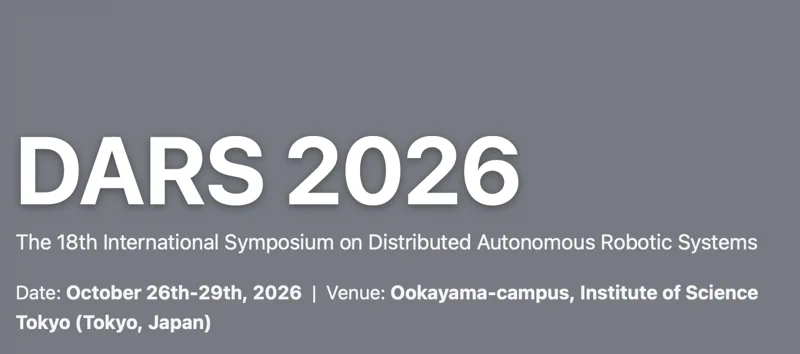
Upcoming Events:26 October 2026 - 29 October 2026
Location:
About the Event
Bin the trope of the solitary, brooding automaton. The future isn’t a lone wolf; it’s a chattering, coordinated, and occasionally chaotic collective. For the architects of this hive-mind future, the biennial pilgrimage to Tokyo for the 18th International Symposium on Distributed Autonomous Robotic Systems (DARS 2026) from 26–29 October 2026, is essentially mandatory.
Since its inception in 1992, DARS has occupied a bespoke niche as the premier single-track summit for the multi-robot world. That’s the key: no parallel sessions to trigger “FOMO” or the decision paralysis of wondering if the real breakthrough is happening in the room next door. Every presentation is a plenary, ensuring the entire community grapples with every milestone, from swarm dynamics to distributed perception. This format breeds the kind of granular, high-level debate that you simply won’t find in the cavernous, impersonal halls of a massive multi-track convention centre.
The symposium acts as a lighthouse for top-flight academics, post-docs, and PhD students currently wrestling with the “wicked problems” of making robot teams actually function in the wild. Whether you’re crafting algorithms for multi-robot choreography, debating the ethics of human-swarm interaction, or chasing the dragon of collective embodied intelligence, these are your people. You’ll head home with a brain buzzing with new concepts and a Rolodex of collaborators who understand why, in this field, one robot is never enough.
Key Numbers
DARS has always prioritised substance over sheer volume, but the stats still paint a picture of a heavyweight institution:
- 18th Edition: This isn’t some flash-in-the-pan workshop; it’s a foundational pillar of the robotics community.
- 34+ Year History: The symposium has been steering the course of distributed robotics since 1992.
- 1 Single Track: Every attendee. Every paper. Every debate. One room, maximum intellectual cross-pollination.
- 2 Prestigious Paper Awards: The intellectual equivalent of a heavyweight title bout for the coveted Best Paper and Best Student Paper awards.
- Dozens of Research Topics: From modular robotics to “trustworthy” distributed systems, the call for papers spans the entire multi-robot spectrum.
Important Dates
For the researchers currently burning the midnight oil on their next submission, get these dates in your calendar. The DARS organisers have laid them out with refreshing lack of ambiguity.
| Milestone | Date |
|---|---|
| Paper Submission Deadline | 20 March 2026 (with a grace period until 1 May) |
| Notification of Acceptance | 1 July 2026 |
| Late Breaking Results/Demo Submission | 1 August 2026 |
| Camera-ready Papers Due | 1 August 2026 |
| Symposium Dates | 26–29 October 2026 |
Venue & Getting There
DARS 2026 will be held at the Ookayama Campus of the Tokyo Institute of Technology (Tokyo Tech), a powerhouse of scientific innovation tucked away in one of the world’s most electrifying cities.
- Address: 2 Chome-12-1 Ookayama, Meguro City, Tokyo 152-8550, Japan.
- Transport: The campus is a mere one-minute stroll from Ōokayama Station, which is served by the Tokyu Oimachi and Tokyu Meguro lines. It’s a doddle to reach from major hubs like Shinagawa, Meguro, and Oimachi, as well as both Haneda (HND) and Narita (NRT) airports.
If you’re looking for a base of operations, the nearby districts of Meguro and Shibuya offer everything from high-end luxury to more modest, budget-friendly “business hotels,” all just a few stops away on the train.
Key Themes
The symposium is looking for papers that explore how robots can be taught to play nicely in the sandbox. Expect deep dives into:
- Swarm Robotic Systems: Because one robot is lonely, and a thousand are a logistical nightmare we’re here to solve.
- Multi-robot Motion Coordination: Choreographing the intricate dance of dozens of machines without them ending up as a pile of very expensive scrap metal.
- Collective Embodied Intelligence: Exploring how a group of simple bots can exhibit complex, “smart” behaviour—proving the whole is often more daunting (and ingenious) than the sum of its parts.
- Human-Swarm Interaction: How to command an army of autonomous agents without accidentally triggering a T-1000 scenario.
- Modular and Self-Assembling Systems: Robots that build themselves and each other. Brilliant, if slightly unnerving.
- Distributed Perception and Planning: Giving robot teams a shared worldview and a coherent plan of attack.
Awards and Recognition
While DARS sadly lacks a robot sumo wrestling category (a missed opportunity, if you ask me), the intellectual competition is just as fierce. The symposium honours standout work through two primary accolades:
- Best Paper Award
- Best Student Paper Award
Securing one of these is a massive feather in the cap, marking out research that is not only original but has the potential to shift the needle for the future of distributed autonomous systems.
Featured Speakers
The official roster of keynote and plenary speakers for DARS 2026 is still under wraps. However, if the past is any prologue, expect to see the titans of the industry. Previous years have seen luminaries from the likes of MIT, Harvard, and EPFL, setting a high bar for the 2026 programme. Keep your eyes on the official DARS site for announcements as we get closer to the date.
Exhibition & Industry
While DARS is an academic heavyweight at its core, it provides a vital forum for sponsors and exhibitors to rub shoulders with leading researchers. The exhibition is likely to showcase the latest hardware, sensors, and simulation platforms that are currently powering the next generation of multi-robot systems.
Travel Grants & Funding
Details on travel grants and student funding haven’t been released just yet. Typically, conferences of this calibre offer support programmes to help students and early-career researchers offset the costs of attendance. We recommend monitoring the official DARS 2026 website for updates on eligibility and how to apply.
Schedule
The full day-by-day breakdown will be released closer to the event. For now, plan for a packed four-day, single-track schedule running from 26 to 29 October 2026. The programme will be a mix of intensive technical sessions, rigorous Q&A, and dedicated networking events. A “Late Breaking Results & Demo” session will also provide a stage for the very latest, “hot-off-the-press” findings.
Registration
Registration for DARS 2026 isn’t live yet. Pricing tiers are expected to be announced on the official symposium website soon. Based on previous years, expect tiered rates for students, regular attendees, and members of affiliated professional societies.
Keep your eyes peeled on the official DARS 2026 registration page for the latest updates. For any specific queries, you can reach the organisers at [email protected].