Upcoming Events:22 August 2026 - 26 August 2026
Location:
About the Event
Forget your usual summer of sport; the androids are coming to town, and they’ve traded tracksuits for titanium. The 2nd World Humanoid Robot Games is set to descend upon Beijing from August 22-26, 2026, and it’s shaping up to be less of a polite academic symposium and more of a full-throttle metallic Olympics. After a relatively quiet debut in 2025, the organisers have clearly decided that subtlety is for humans. The number of mechanical competitors has quadrupled, promising a glorious spectacle of whirring servos and the occasional spectacular tumble.
Hosted at the iconic National Speed Skating Oval—better known as the “Ice Ribbon”—this is where cutting-edge theory meets the cold, hard reality of physics. The brains behind the operation at the Beijing Municipal Bureau of Economy and Information Technology are refreshingly blunt about the stakes: this is about turning R&D into cold, hard cash. As director Jiang Guangzhi put it, the goal is to help these machines “turn medals into orders,” moving them straight from the podium to the warehouse floor. Whether you’re a robotics engineer or just someone who wants to see if a bipedal robot can nail a standing long jump without face-planting, this is the place to be.
The competition has lured in teams from the world’s heavy hitters—the US, Germany, and Japan—setting the stage for a proper clash of engineering philosophies. But the mission remains singular: to see how humanoids handle the messy, unpredictable environments we live in, from factory lines to hotel lobbies. If you want a sneak peek at your future robotic butler (or, let’s be honest, our eventual overlords), you won’t want to miss this.
Key Numbers
The scale of this year’s event is, frankly, staggering. We’re moving well beyond the “hobbyist” phase and into something much more formidable.
- 2,056 robots will be in the mix, a massive fourfold jump from the 500+ we saw at the inaugural games.
- 666 teams have signed up to compete, more than doubling last year’s 280.
- 16 countries are sending their best, including a Brazilian national squad made up of five specialist RoboCup teams.
- 51 distinct events are on the cards (30 competitive sports and 21 real-world scenarios), nearly doubling the 26 events from 2025.
- 1,301 competition sessions will be squeezed into the schedule, up from a mere 487 last year.
- 108 teams are registered for “dancesport” alone—because nothing says “the pinnacle of Western civilisation” like a robot attempting a cheeky waltz.
Important Dates
Get these in your diary. The bots are landing in late August.
| Milestone | Date |
|---|---|
| Opening Ceremony | August 22, 2026 |
| Competition Days | August 22 - 26, 2026 |
| Closing Ceremony | August 26, 2026 |
Venue & Getting There
The games are taking over the National Speed Skating Oval (The Ice Ribbon) in Beijing. It’s a stunning piece of architecture left over from the 2022 Winter Olympics, and there’s a certain poetic irony in watching the next generation of humanoids sprint and stumble in an arena built for peak human athleticism.
Located in the Beijing Olympic Park, the venue is easy enough to reach via the city’s sprawling subway network (take Line 8 or Line 15 to Olympic Green Station). There are plenty of buses, too, but given the expected crowds, the Tube is your best bet unless you fancy spending your afternoon stuck in a legendary Beijing gridlock.
Program Highlights
The event is split into two distinct flavours: pure athletic grit to test the limits of hardware, and scenario-based trials to see if these things are actually useful.
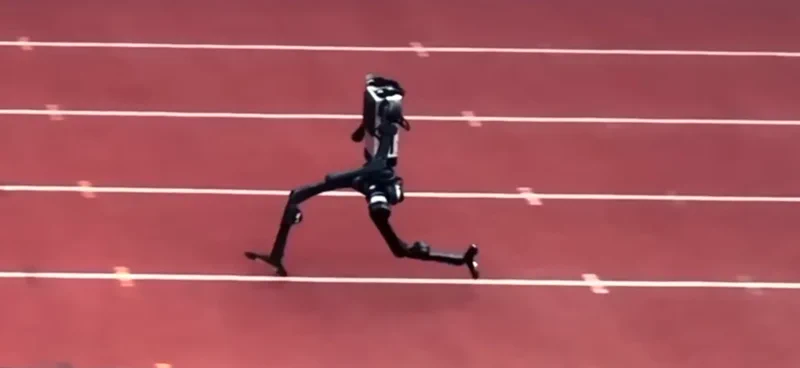
- Track & Field: The classics are back, but the time limits are properly brutal this year. The 100m sprint has to be clocked in under a minute, and the 400m in under five. We’re also seeing the debut of the standing long jump.
- Strength & Combat: For those who just want to see robots scrap, this is the one. Expect freestyle fighting and the debut of weightlifting, with gold medals for both lightweight and heavyweight divisions.
- Ball Sports: Robot football is finally growing up. We’re promised actual dribbling, tactical shots, and diving saves—a significant step up from the “accidental kicking” of previous years. Table tennis is also making its first appearance.
- Scenario-Based Tasks: This is the “real world” test. Robots will be tasked with housekeeping, emergency response, sorting library books, and even picking up beans to prove their fine motor skills aren’t just a fluke.
- Dancesport & Gymnastics: In a display that’s sure to be as impressive as it is surreal, 108 teams will compete in street dance, ballroom, and cheerleading. They’ve dialled up the difficulty, so expect some ambitious—and potentially disastrous—choreography.
Competitions
This isn’t just a glorified tech demo; it’s a high-stakes battle of code and carbon fibre. The rulebook has been tightened to weed out the weak: full autonomy is now the gold standard. Teleoperation (remote control) is largely a thing of the past; these bots have to think for themselves.
The expansion to 51 events includes some cracking new additions. The tug-of-war will be a pure test of torque and stability, while the long jump will push dynamic balance to the edge. The scenario events have also evolved, with more “head-to-head” matches where four robots compete simultaneously rather than just racing against the clock. To keep things fair, there’s an army of 223 referees—a hundred more than last year—ready to blow the whistle on any dodgy sensors.
Exhibition & Industry
While we’re still waiting on the final exhibitor list, the event is essentially a lighthouse for China’s booming robotics sector. With 157 companies and 200 universities involved, the sidelines will be a massive trade fair and recruitment drive. Expect to see the big Chinese players showing off their latest platforms, hoping to snag an investor’s eye. This is where the “competition prototype” tries to prove it’s ready for a proper job in the real world.
Schedule Highlights
The minute-by-minute breakdown is still under wraps, but the organisers have teased some “must-see” moments:
- Opening Night (Aug 22): Things kick off with a 7-a-side football exhibition, followed by the opening heats for the 100m and 400m sprints.
- Super Sunday (Aug 23): The busiest day for the podium, with 12 gold medals being handed out across various disciplines.
- The Heavyweights (Aug 24): The robot “strongmen” take to the stage in the evening for the weightlifting finals.
- Grand Finale (Aug 26): The games conclude with the 5-a-side football finals and the crowd-favourite freestyle fighting, followed by the closing ceremony.
Registration
Watching the future unfold is surprisingly easy on the wallet.
Tickets for the competition days start at a modest 98 CNY (roughly £11), while the opening and closing ceremonies start at 128 CNY (£14). There are also various group packages if you’re bringing the whole lab.
If you’re in mainland China, you can grab tickets via the “Chaopiao Saiyan” WeChat mini-program, Damai, or Maoyan. For international visitors, your best bet is to head straight to Damai International.