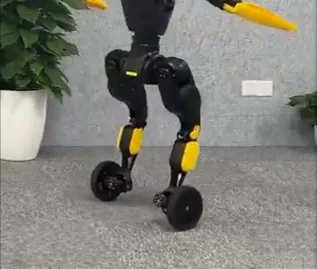
In the increasingly crowded Thunderdome of humanoid robotics, making an entrance requires something more than just walking and waving. EngineAI, a company that clearly has a flair for the dramatic, understands this. Their latest creation, the EngineAI T800, isn’t just another bipedal bot; it’s an absolute beast on paper, capable of pulling off flying kicks and being marketed for an actual “Robot Boxer” competition. This is either a stroke of marketing genius or a sign that we’re skipping the useful-assistant phase and heading straight for the sci-fi spectacle, perhaps with a side order of robot fisticuffs.
Let’s be clear: the hardware is genuinely impressive. The official product page and launch details from the World Robot Conference 2025 paint a picture of a seriously capable machine. It’s a spec sheet that reads less like a factory assistant and more like a dystopian sci-fi protagonist fresh out of a blockbuster. But as we’ve learned from countless overhyped demos, a robot is more than the sum of its actuators. The real question is, behind the high-kicking acrobatics, is there a functional product ready for the real world, or just a very expensive party trick?
All Brawn, No Compromises
Digging into the T800’s vital statistics reveals a machine built for sheer performance. Depending on which press release you read – and honestly, who has time for all of them these days? – it stands between 5ft 8in and 6ft 1in tall and weighs in at a hefty 75-85kg. This isn’t some lightweight research platform; it’s a full-sized unit designed for heavy-duty tasks, clearly not for those with weak knees.
The key specifications are enough to make any robotics engineer raise an eyebrow in appreciation, perhaps even spill their cuppa:
- Peak Performance: Its joints can produce a staggering 450 N·m of maximum torque, enabling the dynamic and powerful movements seen in its demos. That’s enough oomph to make you wonder what it could do on a Monday morning.
- Advanced Mobility: With up to 41 degrees of freedom, the T800 possesses a range of motion that mimics, and in some ways exceeds, human agility. Think Olympic gymnast, but with more circuits.
- Next-Gen Power: Perhaps most notably, it’s powered by a solid-state battery. This is a significant leap forward, offering higher energy density, faster charging, and a much lower risk of the kind of thermal runaway that gives warehouse managers actual nightmares, not just a dodgy night’s sleep.
- Dexterous Manipulation: The hands feature 7 degrees of freedom each, with a payload capacity of 5kg, integrated with tactile sensing for fine-grained operations. So it can probably pick up a dropped biscuit without crushing it – a true innovation.
This is, without a doubt, a formidable piece of hardware. The inclusion of a solid-state battery alone places the T800 at the absolute cutting edge, solving many of the endurance and safety problems that plague current-generation robots. It’s a proper bit of kit.
The Million-Dollar Question: How Do You Use It?
Herein lies the rub, the very sticky wicket that often trips up even the most promising tech. For all its physical prowess, EngineAI’s official channels are conspicuously quiet about the software, the development environment, and the actual process of programming the T800 to do something genuinely useful. The product page mentions support for “secondary development” and a high-compute module, but the specifics are nowhere to be found. It’s a bit like buying a supercar and finding out the keys only unlock the glove compartment.
This is the critical hurdle where many robotics companies stumble, often face-planting spectacularly. A robot without an accessible and robust software development kit (SDK) is just an expensive, high-tech puppet, albeit one that can deliver a knockout punch. We’ve all seen the impressive demos, like the {< crosslink “c4936909-dd70-4944-93ad-ee1d3914fe00” >}, which are brilliant for a highlight reel, but a product is more than just a slick video. How does a company integrate this into a factory line? How does a researcher program it to test a new AI model? The official site promises it can be used for everything from hotel service to factory collaboration, but offers no roadmap for how to get there. It’s all a bit ‘pie in the sky’ without the ‘how-to’ guide.
While the company has mentioned it plans to “open source the robot code for customization and training purposes” in relation to its combat tournament, it’s unclear if this applies to a broader, commercially supported software stack. Without a clear and powerful API, the T800 risks becoming a solution in search of a problem, or worse, a very well-built paperweight.
The Humanoid Hunger Games
The T800 doesn’t enter the market in a vacuum. Oh no. It steps into a fiercely competitive arena, a proper gladiatorial contest populated by contenders from Tesla, Figure AI, UBTECH, and Boston Dynamics. While most competitors are laser-focused on the rather mundane, yet critical, tasks of logistics and manufacturing—stacking boxes, moving totes, and working on assembly lines—EngineAI has taken a decidedly different, and frankly, more aggressive marketing tack. They’ve gone for the jugular, or at least, the viral video.
The “combat-ready” angle and the “Mecha King” tournament are certainly attention-grabbing, a real spectacle designed to showcase the T800’s dynamic stability and power. This strategy could be a rather clever way to stress-test the hardware in the most demanding way possible before deploying it into more mundane industrial settings. After all, if a robot can survive a boxing match, it can probably handle sorting packages without breaking a sweat, or, you know, an expensive servo.
Yet, this focus on combat and acrobatics feels a tad like a distraction from the real challenge: creating a versatile, intelligent machine that can be easily integrated into the economy and actually earn its keep. While Boston Dynamics also creates viral videos of its robots dancing (and let’s be honest, they’re brilliant), it backs them up with a mature software platform in Spot. EngineAI has shown us the flash, the razzmatazz, but we’re still waiting for the substance. It’s all sizzle, no steak, as they say.
The T800 is a paradox. It is simultaneously one of the most physically impressive humanoid robots announced to date and one of the most enigmatic in terms of practical application. The hardware, particularly the solid-state battery, sets a new benchmark. However, the deafening silence on the software and developer ecosystem is a major red flag, waving like a frantic semaphore.
Is the EngineAI T800 the future of automation, or is it just the world’s most advanced remote-controlled action figure, albeit one that could probably beat you in a fight? Until EngineAI provides a clear answer on how customers can actually harness its power and put it to work, the jury will remain out, probably scratching their heads. The hardware is ready for a proper dust-up, but the real battle, my friends, will be won with code.