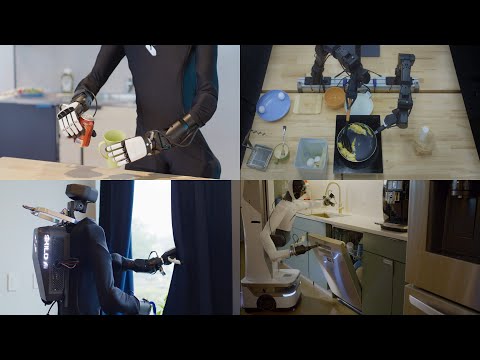
In the grand, often stumbling, marathon toward general-purpose robots, the industry has repeatedly tripped over the same stubbornly high hurdle: data. While language models got to gorge themselves on the entire internet – a veritable smorgasbord of textual delights – robotics, meanwhile, has been stuck spoon-feeding its metallic offspring a rather paltry, pricey, and painfully slow diet of teleoperation. But now, a plucky startup named Skild AI has decided to ditch the baby food and simply show its bots the full à la carte menu. Their latest proof point? A robot arm that can rustle up a cracking plate of scrambled eggs after learning the skill by merely observing a human video.
This, my friends, is no mere parlour trick. It’s a full-frontal assault on what has become the Gordian knot of physical AI: the dreaded data bottleneck. The prevailing method of training robots involves human operators remotely “puppeteering” a machine like some digital Punch and Judy show to collect the precise motor-control data needed for a task. As Skild AI points out, this strategy is hobbled by two rather glaring flaws: it lacks diversity, as most data is collected in pristine, utterly sterile lab environments, and it’s mathematically quite impossible to scale to the level needed for a true foundation model. One simply cannot hire enough human drone-drivers to keep these bots busy 24/7 to generate the gazillions of data points required.
The YouTube-to-Robot Pipeline: A Masterclass in Digital Mimicry
Instead of attempting to cultivate an even larger, more problematic data farm, Skild AI is plugging straight into the grandest data farm of all: the internet. The company’s luminous core insight is that humanity has, quite unintentionally, already curated an “internet-scale” dataset tailor-made for robotics in the form of YouTube tutorials, those rather addictive TikTok hacks, and a myriad of other instructional videos. The solution, hiding in plain sight, like a particularly obvious elephant in the room, is observational learning – precisely how we carbon-based units learn. We don’t, for instance, learn to pour a perfect pint by painstakingly calculating fluid dynamics; we simply watch a seasoned barkeep do it, and our marvellous squishy brains sort out the rest.
And lo, Skild AI is teaching its digital apprentices to follow suit. By diligently observing videos of humans tackling various tasks, the AI deftly deciphers the underlying intent and the intricate sequence of actions, effectively translating a mere visual demonstration into a symphony of robotic commands.
Now, before you get too chuffed, let’s be clear: it’s not quite that simple. Showing a robot a video of Gordon Ramsay unleashing his culinary fury on a Beef Wellington and expecting a Michelin-star meal to materialise is, alas, still the stuff of pure science fiction – for now. The primary, rather gnarly, technical challenge is what the boffins in the industry have dubbed the “Embodiment Gap.” A human hand, a marvel of biological engineering, boasts 27 degrees of freedom; a rather clunky two-fingered gripper, bless its metallic heart, most certainly does not. Mapping the fluid, almost balletic motions of a human chef onto the rigid, often ungainly joints of a multi-axis robot arm is, to put it mildly, a monumental translation conundrum.
Omni-bodied Learning and the Skild Brain: The AI That Sees All (and Does Most)
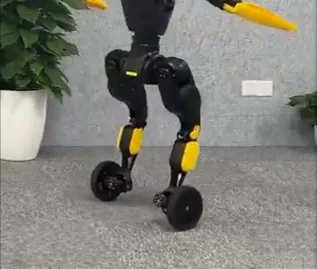
And this, dear readers, is precisely where Skild AI claims its rather delicious secret sauce resides. The company has developed what it calls an “omni-bodied” foundation model, rather grandly dubbed the Skild Brain. This AI is designed to be hardware-agnostic, capable of bossing about various robot forms – from those rather spiffy wheeled humanoids to your more garden-variety stationary arms – without getting overly specialised for any single one. The model is pre-trained on a truly enormous diet of human videos and physics-based simulations, allowing it to build a generalised, almost intuitive, understanding of how objects ought to be manipulated.
“Learning by experience, and not pre-programming, is the veritable game-changer that has finally arrived in robotics,” the company stated, highlighting its rather clever use of NVIDIA’s simulation and AI infrastructure to effectively hoover up “a millennium of experience within days.”
This rather ingenious approach allows the robot to pick up a brand new skill from video with less than an hour of robot-specific data for a spot of fine-tuning. That’s faster than learning to make a decent cuppa! The result is a system that can brilliantly generalise across vastly different tasks and environments, as seen in their rather impressive demos of robots loading dishwashers with an almost human-like finesse, watering plants without drowning them, and even drawing curtains like a seasoned house-sitter.

Implications for the Robotic Revolution: The Future, Unbottled
If Skild AI’s rather bold claims of scalability and effectiveness hold true, then, my dears, the implications are nothing short of monumental. It fundamentally rewrites the entire economic playbook for robot training. The sprawling, eye-wateringly expensive teleoperation farms could well become relics of a bygone era, replaced by powerful models that simply drink from the ever-growing, publicly available wellspring of human activity. This could dramatically accelerate the deployment of robots into those wonderfully chaotic, unstructured environments like our very own homes, bustling restaurants, and even the often-muddy construction sites – places where automation has, quite frankly, traditionally come a cropper.
The wider industry, naturally, is sitting up and taking a rather keen notice. Rivals in the burgeoning humanoid and general-purpose robot space are all placing their own rather hefty, high-stakes bets on cracking this perennial data problem, whether they’re doubling down on teleoperation, simulation, or indeed, human video.
For now, Skild AI has served up a compelling, and dare I say, rather delicious-looking, demonstration. While the rest of us are busy churning out content for humans to binge-watch, Skild is quietly, almost mischievously, transforming that very content into a bespoke curriculum for our future robot assistants. The age of the self-taught robot chef, it seems, might just be simmering closer to reality than we ever dared to imagine.