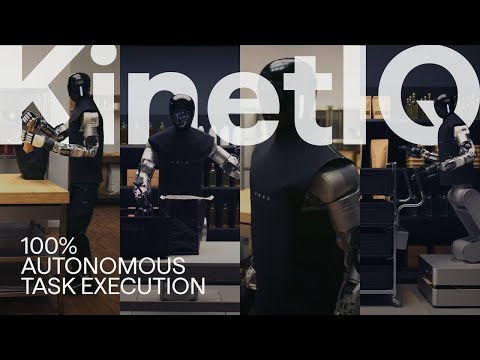
In the high-stakes sprint to engineer the definitive artificial consciousness for humanoid robots, a fascinating philosophical rift is opening up. It is no longer merely a question of who can make a machine walk or fetch a cold drink. The real war is being waged within the very architecture of the robotic mind. On one side, we have the prodigy—the end-to-end savant that learns by observation. On the other, we find the meticulously structured bureaucracy. Stepping boldly into the latter camp is Humanoid with its new AI framework, KinetIQ, a system designed not just to pilot a single robot, but to conduct an entire mechanical orchestra.
This immediately sets the stage for a compelling showdown with Figure AI, whose Figure’s Helix 02: An AI Brain That Finally Does the Dishes has left audiences gobsmacked with its fluid, long-form autonomy. While Figure is obsessed with creating a single, unified neural network capable of mastering complex, multi-step tasks, Humanoid is tackling the far grittier, industrial challenge of fleet management. It is a clash between the virtuoso soloist and the site foreman, and the outcome could dictate how robots integrate into our daily lives for decades to come.
KinetIQ: A Corporate Ladder for Cognition
Humanoid’s KinetIQ is built upon what the firm calls a “cross-timescale” architecture—essentially a four-tier wedding cake of command and control. It is an agentic framework that functions much like a blue-chip corporation, with each layer operating at its own pace and level of abstraction.
At the very top sits System 3, the Agentic Fleet Orchestrator. This is the C-suite, integrating directly with factory or warehouse management software to digest high-level objectives. It operates on a timescale of seconds to minutes, treating every robot in its diverse fleet—whether bipedal or wheeled—as a resource to be deployed for maximum throughput.
One rung down is System 2, the robot-level project manager. This layer employs an omni-modal language model to interpret System 3’s directives, breaking them down into a logical sequence of sub-tasks for an individual unit. It reasons about its surroundings and can pivot its plan on the fly—essentially problem-solving in real-time.
Providing the moment-to-moment instructions is System 1, a Vision-Language-Action (VLA) network acting as the team lead. Operating at a brisk 5-10Hz, it issues a relentless stream of target poses for the robot’s appendages—hands, torso, pelvis—to execute the roadmap laid out by System 2.
Finally, doing the actual grunt work, is System 0. This is the whole-body controller, running at 50Hz and forged exclusively through roughly 15,000 hours of reinforcement learning in simulation. Its sole, frantic purpose is to translate those pose targets into stable, balanced joint movements, ensuring the robot doesn’t end up in a heap on the floor while trying to shift a crate.
Helix 02: The End-to-End Virtuoso
In the opposing corner stands Figure AI’s Helix 02, a system born of a fundamentally different philosophy. Eschewing the multi-layered bureaucracy, Helix 02 is built around a single, unified visuomotor neural network. Its mantra is “all sensors in, all actuators out,” tethering vision, touch, and proprioception directly to every joint in one seamless loop.
While also hierarchical, its structure is far more streamlined:
- System 2 handles the high-level semantic reasoning, akin to KinetIQ’s upper echelons.
- System 1 is where the magic happens. It is a formidable policy that translates perception directly into full-body joint targets at a lightning-fast 200Hz.
- System 0 serves as the foundation for physical embodiment—a controller ensuring movements remain smooth and stable. However, unlike KinetIQ’s pure RL approach, Helix’s System 0 was trained on over 1,000 hours of human motion data, capturing the subtle nuances of human-like balance before being polished with RL. It also operates at a staggering 1 kHz.
This elegant approach is what allowed Figure to showcase its robot autonomously loading and unloading a dishwasher over four minutes—a masterclass in long-horizon autonomy that remains the industry benchmark.
A Tale of Two Brains: A Philosophical Divide
The discrepancies between KinetIQ and Helix 02 aren’t merely technical—they represent two distinct visions for the future of the species.
| Feature | Humanoid KinetIQ | Figure AI Helix 02 |
|---|---|---|
| Primary Goal | Fleet orchestration of diverse robots | Long-horizon autonomy in a single robot |
| Architecture | 4-layer agentic framework | 3-layer unified visuomotor network |
| System 0 Training | ~15,000 hours of pure Reinforcement Learning | 1,000+ hours of human motion data + RL |
| System 0 Speed | 50 Hz | 1000 Hz (1 kHz) |
| Key Strength | Scalability, reliability, and management of varied platforms. | Fluidity, dexterity, and learning complex, novel tasks. |
| Analogy | A well-oiled logistics operation. | A world-class solo athlete. |
KinetIQ’s agentic, layered design is refreshingly pragmatic. By compartmentalising responsibilities, Humanoid can, in theory, refine, debug, or swap out individual layers without having to rebuild the entire brain from scratch. This modularity is spot on for industrial settings where reliability and the coordination of dozens of machines are the top priorities.
Figure’s end-to-end approach is more ambitious, chasing the dragon of general intelligence. By training the system on human data, it aims to create a foundational model for physical action that is inherently more graceful and adaptable to the chaotic, unstructured nature of the real world. It learns how to move like a human, rather than just how to tick a box.
The Real Race: From Dazzling Demos to the Daily Grind
Ultimately, the superior architecture won’t be crowned in a lab, but on the factory floor and, eventually, in our homes. Humanoid is betting that the immediate, multi-billion-pound prize lies in logistics and manufacturing, where the core challenge is choreographing fleets of specialised robots. KinetIQ is purpose-built for that reality.
Figure AI, with its focus on complex, human-centric tasks, appears to be playing the long game, aiming for a true general-purpose robot that can navigate any environment. The breathtaking dexterity they’ve demonstrated—from handling tiny pills to operating syringes with precision—shows a system pushing the envelope of fine motor control.
The race is well and truly on. Will the future of robotics be governed by a meticulous AI fleet manager or a virtuosic robotic prodigy? KinetIQ makes a compelling case for the former—a system designed not for the highlight reel, but for the gruelling, 24/7 reality of industrial deployment. For those wanting to dive deeper, the original announcement can be found at thehumanoid.ai.