For years, owning a robot lawn mower meant accepting a tedious compromise: a weekend spent on your hands and knees, burying a perimeter wire around your property like some kind of suburban metal detectorist. That era is officially over. The robot mower market of 2026 isn’t about the drudgery of setup; it’s a battle of high-level intelligence. The new war is being waged between navigation systems that were, until very recently, the exclusive domain of autonomous cars and military-grade survey drones.
The industry has fractured into competing philosophies. Do you trust satellites with RTK positioning? Lasers with LiDAR mapping? Or artificial intelligence with camera vision? The most audacious new machines, fresh from the halls of CES 2026, have decided the answer is “all of the above.” This guide cuts through the marketing fluff to evaluate the ten best machines you can actually buy, based on real-world tests, expert scoring, and a healthy dose of British skepticism.
The New Rules of Navigation
Before we get to the hardware, you need to understand the silicon brain driving it. A mower’s navigation paradigm is the single most important factor determining its performance. It dictates accuracy, how it handles your prized petunias, whether it works after sundown, and if it will simply give up the ghost under that dense oak tree in the corner of the garden.
Here’s the breakdown of the four technologies vying for control of your turf:
- Perimeter Wire (The Old Guard): A physical wire buried in the ground creates an inductive boundary. It’s reliable for simple, flat lawns but laughably primitive by 2026 standards. Setup is a nightmare, and it offers zero intelligence for obstacle avoidance.
- RTK / NRTK (The Surveyor): Real-Time Kinematic (RTK) uses a local base station to correct standard GPS signals, achieving centimetre-level accuracy. Networked RTK (NRTK) pulls these corrections from the cloud, ditching the need for a plastic antenna in your flowerbed. Both are brilliant for large, open areas but can lose their way near tall buildings or under heavy tree cover.
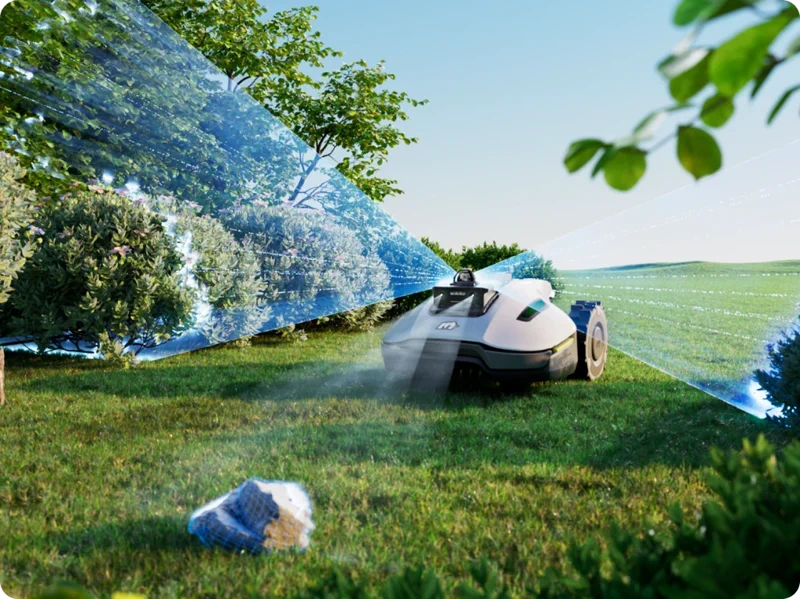
- LiDAR (The Bat): A spinning laser sensor creates a real-time 3D map of its surroundings, just like a self-driving Tesla. LiDAR is the undisputed champion of obstacle avoidance and works perfectly in total darkness. It doesn’t care about satellite signals, making it ideal for complex gardens with lots of trees and architectural quirks.
- AI Camera Vision (The Eyeball): Onboard cameras and trained neural networks identify grass, edges, and obstacles. This is the simplest system to set up—often a true “drop-and-mow” experience. However, most current models are day-blind and can be confused by harsh glare or long shadows.
- Tri-Fusion (The Overlord): The 2026 premium standard. These machines fuse RTK, LiDAR, and AI Vision, using a sophisticated algorithm to rely on whichever sensor is providing the most reliable data at any given moment. This approach effectively eliminates the individual weaknesses of each technology, representing the absolute peak of current performance.
#1 — Mammotion LUBA 3 AWD
Expert Score: 94/100 ⭐⭐⭐⭐⭐
The Mammotion LUBA 3 AWD didn’t just show up at CES 2026; it walked away with an Innovation Award and left its competitors looking distinctly last-gen. Its headline feature is the world’s first Tri-Fusion positioning system—a holy trinity of 360° LiDAR, NetRTK satellite correction, and Dual-Camera AI Vision, all operating in perfect harmony. This isn’t a simple handover system; it’s a constant, real-time fusion of all three data streams. The result is a mower that maintains its precision in the exact scenarios where lesser bots fail: under dense canopies, between tall houses, and in the dead of night.

Its brawn matches its brain. A true all-wheel-drive system allows the LUBA 3 to conquer absurd slopes of up to 80% (38.6°), a figure that is comfortably class-leading. Its dual cutting discs, powered by 165W motors, deliver a massive 400mm cutting width. The AI vision can reportedly recognise over 300 different obstacles, while the entire unit is IPX6 waterproof, meaning you can clean it with a hose without fear. Reviewers have confirmed its prowess in “impossible scenarios,” successfully navigating between solid structures where RTK-only systems usually throw in the towel.
“The LiDAR technology is next level. It’s like the mower has an extra set of eyes. Mowing under trees between two solid structures is mind-blowing—especially if you’ve ever tried to run an RTK system in those scenarios.” — YouTube review
- Navigation: Tri-Fusion: 360° LiDAR + NetRTK + Dual-Camera AI Vision
- Drive: All-Wheel Drive (4WD)
- Max Slope: 80% (38.6°)
- Cutting Width: 400mm
- Price: Starts at £1,999 / €2,299
#2 — Ecovacs GOAT A3000 LiDAR
Expert Score: 87/100 ⭐⭐⭐⭐½
The Ecovacs GOAT A3000 is a testament to the power of laser focus—literally. It forgoes satellite navigation entirely, relying on a sophisticated Dual LiDAR system paired with an AI camera. This makes it the undisputed champion for cluttered, complex gardens where RTK signals fear to tread. A full-season test by Tom’s Guide called it “a game-changer for saving time,” while PCWorld noted its dual-disc blades spin at a ferocious 3,000 RPM.

Setup is disarmingly simple: place the dock, connect to the Wi-Fi, and let it map your garden on its own. Its primary drawback is its rear-wheel-drive system, which limits its slope-climbing ability to a modest 20° and can cause it to struggle in narrow passages. But for homeowners whose gardens are more “assault course” than “open field,” the A3000’s satellite-free reliability is a massive advantage.
“Its LiDAR navigation makes mowing under trees or in enclosed areas just mind-blowing compared to RTK systems. The dual disc blades mean it leaves virtually no tufts.” — Freshly Charged review
- Navigation: Dual LiDAR (360° + 3D ToF) + AI camera
- Drive: Rear-Wheel Drive
- Max Slope: ~20°
- Cutting Width: 330mm
- Price: Around £2,400 (often on sale for less)
#3 — Segway Navimow i2 AWD (2026)
Expert Score: 84/100 ⭐⭐⭐⭐
Segway’s new Navimow i2 AWD is a direct shot at the heart of the market: an affordable, all-wheel-drive, wire-free mower. Unveiled at CES 2026, its navigation relies on a cloud-based NRTK system, eliminating the need for a local antenna. But its real party trick is a three-wheel-drive system called Xero-Turn, which uses a third wheel that engages only when needed for extra traction on slopes up to 24° or on slippery British turf.

This isn’t just a gimmick; test footage confirms the mower stays planted on 45% slopes without slipping or chewing up the grass. It’s also packed with security features like GPS theft tracking and a lift alarm. While its 18cm (7.1-inch) cutting width is modest, its price-to-performance ratio is exceptional, making advanced AWD tech accessible to the average suburban homeowner for the first time.
“Unlike older or cheaper machines that can slip, spin, or damage the lawn, the i2 AWD grips confidently while still being gentle on the grass.” — YouTube mower test
- Navigation: EFLS NRTK + 140° RGB camera
- Drive: 3-Wheel AWD (Xero-Turn)
- Max Slope: 45% (24°)
- Cutting Width: 180mm
- Price: Starts at £899
#4 — Lymow One Plus (“The Tank”)
Expert Score: 81/100 ⭐⭐⭐⭐
Every so often, a product appears that gleefully defies convention. The Lymow One Plus is that product. Instead of wheels, it uses continuous rubber tank treads, giving it unparalleled traction on wet grass, loose soil, and slopes up to a frankly terrifying 100% (45°). Its power output is equally absurd, peaking at 1,785 Watts—more akin to a small petrol mower than a battery-powered robot.

This machine isn’t just for maintaining a lawn; it’s for taming it. The dual rotary blades spin at 6,000 RPM and can handle overgrown grass, leaves, and even light scrub. It even has a built-in mulcher and blower to clear clippings off your driveway. Its navigation is a solid RTK + VSLAM combo, and its LiFePO₄ battery is rated for over 2,000 charge cycles, dwarfing the ~500 cycles of typical Li-Ion batteries. The Lymow is less a lawn mower and more a miniature, autonomous brush hog. For properties that look more like a wilderness than a manicured garden, it’s in a class of one.
- Navigation: RTK + VSLAM
- Drive: Continuous tank treads
- Max Slope: 100% (45°)
- Peak Power: 1,785W
- Price: Starts at ~£2,100
#5 — Mammotion LUBA Mini AWD / YUKA mini 2
Expert Score: 84/100 ⭐⭐⭐⭐
The Luba Mini AWD earned a perfect 5/5 score from Gardenersworld.com for a reason: it packs the core technology of its larger siblings into a compact and more affordable package. It handles slopes up to 38.6° and offers a unique “manual mowing mode” for remote-controlling the unit with a smartphone to touch up those tricky missed spots.

The newer YUKA mini 2 platform refines this concept further. While the base model uses a GPS + camera system, the 1000 variant adds a 360° LiDAR sensor, bringing high-end laser mapping to the mid-size mower market. This upgrade allows it to recognise over 300 obstacles and navigate with centimetre-level precision, even in low light. For those with medium-sized, moderately sloped gardens who still want premium navigation features, the YUKA mini 2 with LiDAR is an incredible value proposition.
- Navigation: GPS + Camera (Mini AWD) / 360° LiDAR + AI Vision (YUKA mini 2 1000)
- Drive: All-Wheel Drive
- Max Slope: 38.6° / 45% (24°)
- Price: Starts at £999
The Future is Modular and Multi-talented
The major trend for 2026 is clear: sensor fusion is no longer a luxury but a baseline for any serious flagship mower. Looking ahead, companies like NexLawn and Roborock are already showcasing their own triple-sensor fusion models. The Roborock RockMow X1 LiDAR, for instance, combines 360° LiDAR with AWD and can climb slopes of up to 80% (38.7°).
Perhaps most intriguing is the rise of modular platforms. The Yarbo M Series, which made a splash on Kickstarter, uses a single tracked base that accepts interchangeable modules for mowing, snow clearing, leaf collection, and trimming. This points to a future where we don’t buy a robot mower, but an all-season autonomous garden robot. NexLawn even demonstrated a concept with an integrated robotic arm for weeding and debris clearing.
The Verdict
The 2026 robot mower market is a fantastic landscape of specialised, intelligent machines. For the user who wants the absolute best, the Mammotion LUBA 3 AWD is the undisputed king, conquering any terrain or navigation challenge thrown at it. For those with complex, obstacle-filled gardens, the pure LiDAR approach of the Ecovacs GOAT A3000 offers unmatched reliability.
However, for the vast majority of homeowners, the Segway Navimow i2 AWD hits the sweet spot, offering modern wire-free technology and capable all-wheel-drive performance for under £1,000. If your lawn is a flat, simple affair and you value ease of use above all, the Eufy E18 offers an almost frictionless setup experience. And for the brave souls taming the wilderness at the edge of their property, the Lymow One Plus isn’t just a mower; it’s a statement. Your lawn’s new robotic overlords have arrived, and they are smarter than ever.