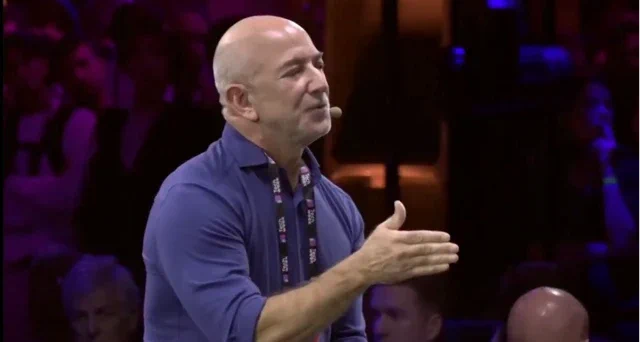
Just when you thought Jeff Bezos was content with the billionaire space race and commissioning superyachts so gargantuan they necessitate dismantling historic bridges, he’s decided to automate the physical world. We’re not talking about cute warehouse bots or Alexa’s latest party trick; we’re talking about a war chest so vast it redefines the very notion of industrial ambition. Bezos is reportedly in talks to raise a staggering $100 billion to snap up manufacturing firms and systematically replace their human workforces with artificial intelligence.
This isn’t some far-flung sci-fi concept; it’s an active fundraising blitz targeting the world’s most powerful sovereign wealth funds and asset managers. According to investor dossiers, the project is being pitched as a “manufacturing transformation vehicle.” It’s a dry, corporate label for what is, in effect, the largest industrial hostile takeover in history. And if you think this is just about tweaking a few assembly lines, you haven’t been paying attention to the Bezos playbook.
Phase One: Assembling the AI Brain Trust
This audacious gambit didn’t just appear out of thin air. It kicked off six months ago with the quiet debut of Project Prometheus, a stealthy AI startup co-founded by Bezos with an initial $6.2 billion injection. His co-CEO is Vik Bajaj, a physicist and chemist who was a key architect of the self-driving car project at Google X that eventually became Waymo.
Prometheus has been ruthlessly poaching top-tier talent from OpenAI, DeepMind, and Meta’s AI labs. Adding some serious gravitas to the roster, David Limp—the CEO of Bezos’s space venture Blue Origin—recently joined the board.
But the tech they’re cooking up isn’t just another chatbot to help you write emails. Prometheus is laser-focused on “digital twins”—hyper-realistic AI simulations of entire industrial ecosystems. These systems are designed to model supply chains, stress-test experimental materials, and engineer complex products from the ground up, all within a virtual vacuum. Imagine an AI that can design a next-gen rocket engine, run a million virtual simulations to find the perfect spec, and then manufacture it flawlessly on the first real-world try. That is the endgame.
Phase Two: Buy the Factories, Install the OS
With the AI engine purring, Bezos has moved to phase two: acquiring the hardware. He’s been on a global charm offensive, pitching sovereign wealth funds in the Middle East and heavyweight asset managers in Singapore, with whispers that JPMorgan Chase is also in the room.
The pitch is brutally simple: Give me $100 billion. I’ll buy the factories. I’ll install my AI. I’ll automate the shop floor. Then, I’ll sell that blueprint to every other manufacturer on the planet.
This is where the strategy pivots away from every other player in the AI arms race.
- OpenAI sells API access.
- Anthropic sells Claude subscriptions.
- Microsoft sells Copilot licences.
They’re all selling tools and waiting for the world to catch up. Bezos is skipping the queue. He’s not licensing software and crossing his fingers; he’s buying the entire production line and force-feeding it his own revolution.
The AWS Playbook for the Physical World
If this sounds familiar, it should. Bezos used this exact strategy to conquer retail. Amazon didn’t just sell inventory software to bookshops—it became the bookshop. Then it became the department store, the supermarket, and the chemist. Then, with Amazon Web Services (AWS), it became the foundational plumbing for a third of the internet.
Now, he’s applying that logic to the means of production. The fund is specifically eyeing industries that form the backbone of national power: semiconductors, defence, and aerospace. These are sectors that governments simply cannot afford to let falter.
The strategic brilliance is as undeniable as it is chilling. Once Bezos owns and automates these critical manufacturing assets, governments could find themselves as dependent on his AI infrastructure as the Pentagon and the intelligence community are on AWS. The man who automated how the world shops is now positioning himself to automate how the world builds.
And the financial engineering is classic Bezos. He’s executing this grand vision primarily with other people’s capital, while his own stake via Prometheus is a mere fraction of the total. If the $100 billion fund hits a wall? The sovereign wealth funds and asset managers carry the can. If it succeeds? Bezos controls the AI operating system for global manufacturing. At a conference in Italy last year, Bezos noted, “AI can have a huge impact on every company in the world, including manufacturers.” It wasn’t just a casual observation. It was a declaration of intent.