Let’s be clear: NASA’s latest blueprint for a permanent lunar base isn’t some nostalgic “flags and footprints” exercise. This is about infrastructure, heavy industry, and staring down an environment so hostile it makes a mockery of our terrestrial engineering conceits. The agency, led by Administrator Jared Isaacman, has attached a staggering price tag to this ambition: $30 billion, 79 launches, and 73 landers over the next 11 years—all to establish a permanent human foothold on the rim of Shackleton Crater.
This isn’t some far-off sci-fi pipe dream. This is the official Moon to Mars architecture, a concrete roadmap for learning how to survive on another world. But before the first long-term residents can start moaning about the lack of decent high-street coffee, an army of robots will have to build their home. And they’ll have to do it while battling an enemy that Apollo astronauts learned to dread: dust. Not the benign fluff that gathers on your skirting boards, but a microscopic menace sharp enough to shred solid steel.
The Blueprint for a Lunar Beachhead
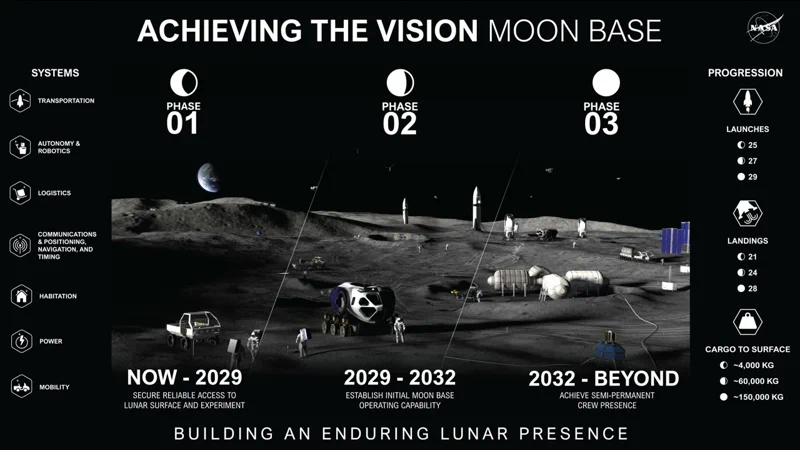
The grand strategy is divided into three aggressive phases. Phase One, running from now until 2029, is the robotic vanguard’s time to shine. It involves a steady cadence of commercial payload deliveries—up to 25 missions—to scout the terrain, stress-test technologies, and begin deploying the first bits of hardware. This is where NASA’s Commercial Lunar Payload Services (CLPS) initiative takes centre stage, with firms like Intuitive Machines, Astrobotic, and Firefly Aerospace acting as the solar system’s most ambitious delivery drivers.
Phase Two (2029-2032) is when the outpost actually starts to look like a base. This involves establishing “initial operating capability”—NASA-speak for setting up the power grid and dropping off the heavy kit. The centrepiece is a 40-kilowatt nuclear fission reactor; because when the lunar night plunges temperatures to -203°C for 14 Earth days, solar panels become little more than expensive ornaments. Finally, Phase Three (2032 onwards) aims for a “semi-permanent crew presence,” evolving into the first continuously inhabited human settlement on another celestial body.
The location, Shackleton Crater at the South Pole, is a strategic masterstroke. Its rim enjoys near-perpetual sunlight for power, while its permanently shadowed floor hides billions of years’ worth of frozen water ice—the solar system’s most precious resource for drinking, breathing, and refining rocket fuel.
The Real Boss: A Microscopic Grain of Terror
Glossy renders of gleaming habitats look brilliant on a pitch deck, but they conveniently ignore the single greatest engineering headache of a permanent lunar presence: regolith. Lunar dust is a total nightmare. Without wind or water to erode it, every single particle is a microscopic shard of glass and rock. It’s electrostatically charged, meaning it clings to everything it touches. During the Apollo missions, it chewed through layers of spacesuit fabric, gummed up delicate mechanisms, and caused equipment to overheat.
“We learned from Apollo that lunar dust can be less than 20 microns… very fine, abrasive and sharp, like tiny pieces of glass, making it more of a dangerous threat than just a simple nuisance.” - Sharon Miller, NASA Glenn Research Center
Now, imagine robotic systems designed to operate not for 75 hours, but for years on end. Every joint, seal, solar panel, and connector is a potential point of catastrophic failure. The chasm between a three-day Apollo jaunt and a permanent outpost is the engineering problem that keeps scientists up at night. This is where the real war will be fought, not by astronauts, but by robotic systems built for unprecedented durability and, crucially, autonomous self-repair.
Rise of the Robotic Grafters
Humans are fragile, expensive cargo. The dirty, dangerous, and repetitive graft of building “Moon Base Alpha” will fall to a new generation of space-hardened robots. We are looking at a robotic ecosystem far more sophisticated than anything we’ve ever launched.
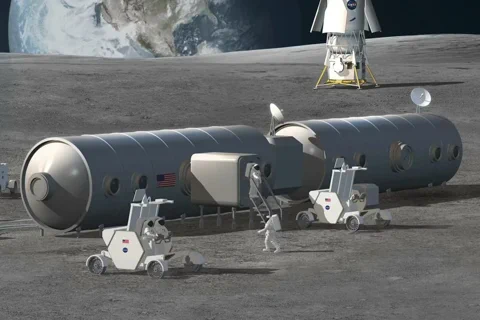
- Construction Bots: Autonomous rovers will be tasked with levelling the lunar terrain, winching modules into place, and piling up berms for radiation shielding. Companies like Astrolab and Lunar Outpost are already perfecting the Lunar Terrain Vehicles (LTVs) that will serve as the workhorses for both machines and humans.
- Mining and Utility Drones: To tap into that vital water ice, NASA envisions a fleet of robotic systems, including hopping “MoonFall” drones inspired by the Mars Ingenuity helicopter, capable of diving into treacherous, pitch-black craters.
- Nuclear Technicians: Deploying and maintaining a fission reactor on the Moon is a job you’d much rather delegate to something that doesn’t have DNA to worry about. The Fission Surface Power project is one of the most critical—and robot-dependent—pillars of the entire mission.
This robotic workforce won’t just be remote-controlled from a desk in Houston. The communication lag and the sheer complexity of the work demand high levels of autonomy. These machines will need to diagnose their own glitches, navigate lethal terrain, and collaborate with one another to get the job done.
The Real Prize: Mars
As audacious as a $30 billion Moon base sounds, it is effectively a dress rehearsal. NASA has been explicit: every scrap of technology and operational experience gained on the Moon is a direct stepping stone to putting boots on Mars. Learning to extract water, generate nuclear power, and build habitats in a vacuum just a few days’ flight from home is infinitely more sensible than trying to wing it on a planet that’s a six-month journey away.
The multi-planetary economy is no longer a sci-fi trope; it’s a line item in the budget. While legacy aerospace firms struggle to get capsules into low-Earth orbit, NASA is architecting a future where commercial heavy-lifters like SpaceX’s Starship act as the freight trains for a new industrial frontier. The first pioneers on this frontier won’t be made of flesh and bone. They’ll be made of metal and silicon, and their primary job is to survive the dust. If they can pull it off, humanity might just have a future beyond this pale blue dot.