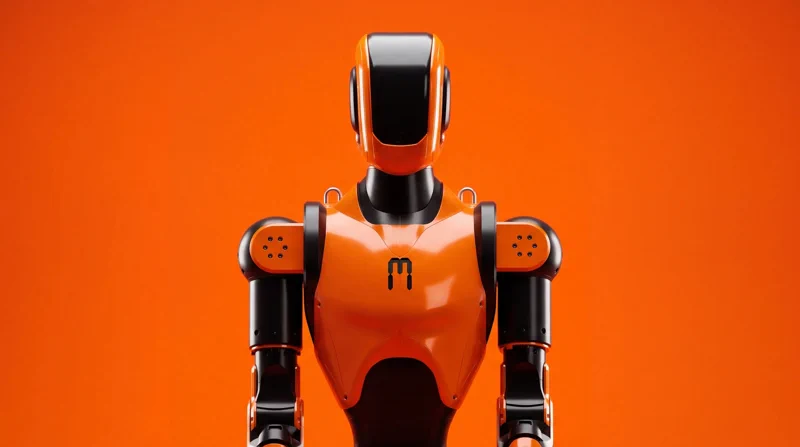
If you’ve ever glanced at the polished, uncanny-valley perfection of a Boston Dynamics or 1X humanoid and thought, “I could do that, if only I had a spare clean room and a Silicon Valley venture fund,” then Singapore-based Menlo AI has a proposition for you. It’s called the Asimov 1, and for the same $20,000 (roughly £15,500) price tag as a pre-ordered 1X Neo, it offers a radically different vision of the future. Instead of a sleek, autonomous butler, you get a collection of parts in a box.
This is essentially the IKEA flat-pack of bipedal robotics, complete with a bill of materials that will make your bank manager wince and an instruction manual for a build estimated to take over 100 hours of painstaking labour. It is a bold, almost absurdly nerdy counter-pitch in a world obsessed with turnkey solutions. And, frankly, it might just be brilliant.
Your Next 100-Hour Project
Let’s be clear: the Asimov 1 is no toy. This is a serious research platform masquerading as the world’s most daunting Meccano set. Standing 1.2 metres tall (roughly 4ft) and weighing in at 35kg, its frame is a sophisticated blend of CNC-milled 7075 aluminium for critical load-bearing structures and Multi Jet Fusion PA12 nylon for the rest. This isn’t some wobbly, 3D-printed hobbyist project; it’s engineered for proper repeatability and industrial-grade robustness.
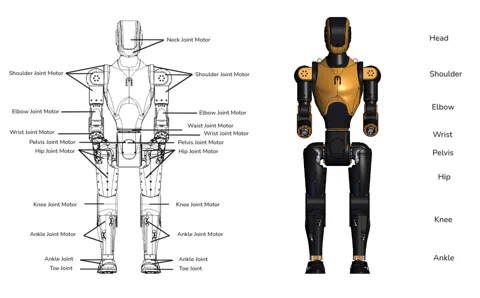
Under the bonnet, the robot features 25 powered joints plus two passive, spring-loaded toe joints, giving it a total of 27 degrees of freedom. This allows for some respectable, if not quite Olympic, performance metrics: a 5kg squat, 18kg lateral raises per arm, and a walking speed of 3km/h (about 2mph) with a two-hour battery life.
The “brain” is a clever twin-computer architecture. A Raspberry Pi 5 handles the high-level heavy lifting—networking, audio, and crunching data from its 2MP monocular camera and microphone array—while a more specialised Radxa CM5 board manages the hard real-time motor control. It’s a pragmatic design choice that prioritises accessibility and cost-effectiveness over exotic, proprietary silicon.
An Open Platform in a Closed World
The core philosophy of Asimov 1 is radical transparency. While most robotics firms guard their designs like the crown jewels, Menlo AI has dumped everything on GitHub—the CAD files, wiring schematics, and the complete Bill of Materials (BOM). You don’t even have to buy the $20,000 kit; you could, in theory, source every last nut, bolt, and actuator yourself, though the company points out their bulk pricing saves builders around $11,000 compared to going it alone.
This openness directly addresses a common frustration in the research community. When a user on X asked why they shouldn’t just opt for a 1X Neo, the company’s response was telling.
Asimov Inc (the project’s official handle) elaborated on this ethos:
“It’s a robot you can make your own. We believe thousands of builders can make better robots together if someone hands them an open foundation. That is what Asimov 1 is here for.”
This brings us to the most glaring omission: the robot has no hands. This isn’t an oversight; it’s a statement of intent. Menlo AI is providing the platform—the legs, the torso, the brain—the foundational elements of humanoid locomotion. It’s up to the global community of builders and researchers to decide what they actually do with it. It’s a “bring-your-own-gripper” party, and everyone is invited.
A Tale of Two $20,000 Humanoids
The contrast with the 1X Neo couldn’t be starker. Both platforms sit at the $20,000 mark, but they represent two fundamentally different futures.
- 1X Neo: A polished, consumer-facing appliance. It arrives fully assembled, ready to (eventually) fold your laundry. It is significantly stronger, capable of lifting up to 70kg, but operates as a “black box.” You are a user of their ecosystem.
- Asimov 1: A transparent, developer-focused kit. It arrives in pieces, demanding significant technical graft to assemble. Its capabilities are more modest, but every screw and line of code is open to modification. You are a co-creator of the platform.
This isn’t really a competition; it’s a bifurcation of the market. The Neo is for those who want the service a humanoid can provide, while the Asimov 1 is for those who want to define what that service looks like.
The open-source approach could act as a powerful catalyst for the entire field. By providing a common, affordable, and robust hardware baseline, Menlo AI is creating a standardised sandbox for researchers to test new AI models and control policies. Instead of reinventing the bipedal wheel, labs can now focus on the soul in the machine. The future of robotics may not be forged in a secretive corporate lab, but rather assembled, debugged, and perfected in a thousand different garages and universities across the globe.