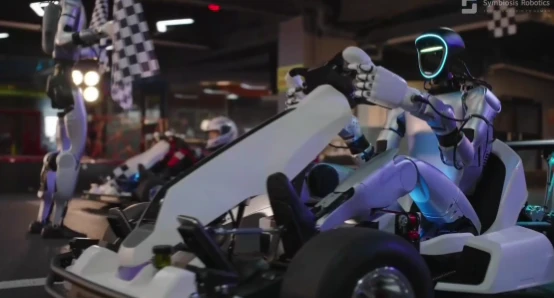
Just when you thought the humanoid robot arms race couldn’t get any more crowded, a brand-new startup has kicked down the door, slung a robot into a go-kart, and proceeded to do donuts in the car park. Meet Symbiosis Robotics, a Chinese firm that has burst out of stealth mode with a video of a Unitree G1 humanoid not just driving, but drifting a go-kart. It’s the kind of flashy, slightly absurd demonstration that demands your attention, because beneath the screeching tyres lies a serious bit of technological kit.
This isn’t some remote-controlled puppet show. The robot is autonomously performing a complex sequence: folding its frame into a cramped cockpit, gripping the wheel, finding the pedals, and executing a continuous chain of perception, balance, and whole-body control to navigate the track. It’s a bold statement from a company that, by all accounts, was founded barely a month ago.
The Brains: One Model to Rule Them All
The secret sauce behind this mechanical Schumacher is an AI model Symbiosis calls Direct Perception Control (DPC). The company claims DPC is an “end-to-end perception-control integrated foundational model” that fundamentally rips up the rulebook on how robots operate. For decades, the dominant robotics paradigm has relied on a layered, modular stack: one system for perception, another for high-level planning, and a third for twitching the joints. It works, but it’s often brittle—one tiny error in the perception layer can snowball into a catastrophic failure at the finish line.
Symbiosis’s DPC model throws that playbook out of the window. It directly maps multimodal sensory inputs—vision, language, body state, and physical haptics—straight to the robot’s joint and hand targets. In their own words, it breaks the barrier between the robot’s “brain” (perception) and “cerebellum” (motor control), allowing them to be optimised simultaneously. This is the holy grail of embodied AI: a single, unified model that simply perceives and acts.
To build this digital brain, Symbiosis fed it a diverse diet of 15,010 hours of training data. The dataset included 6,781 hours of human egocentric video, 4,024 hours from robotic arms, and thousands of hours from wheeled and bipedal humanoids. This variety is the key to building a model that can generalise across different tasks and physical forms.
The Body: An Off-the-Shelf Workhorse
Perhaps the most telling detail of this whole affair is the robot itself. This wasn’t some bespoke, multi-million-pound research platform. The pilot was a Unitree G1, a commercially available humanoid that has quickly become the go-to “dev kit” for researchers. Standing about 4ft 2in (1.27m) tall and weighing around 35kg, the G1 is a capable, if relatively modest, piece of hardware.
With 23 to 43 degrees of freedom, a walking speed of 2m/s, and a payload of around 2kg per arm, it’s a solid platform. Crucially, the base model sells for under $20,000 (roughly £15,500), a price point that puts it in a different universe from the likes of Boston Dynamics’ Atlas. By using an off-the-shelf robot, Symbiosis is making a clear point: the real revolution isn’t in exotic hardware, but in the intelligence that drives it.
Why a Go-Kart is a Deceptively Hard Test
Driving a go-kart might seem like child’s play for a human, but for a robot, it’s a brutal exam of whole-body intelligence. This isn’t just walking across a room; it’s a continuous test of multiple, interwoven skills:
- Constrained Manipulation: The robot has to physically squeeze into and operate within the tight confines of a driver’s seat—a major challenge for spatial awareness.
- Hand-Eye-Foot Coordination: It must simultaneously track the track ahead, steer with its hands, and apply nuanced pressure to the pedals.
- Precise Force Control: Drifting and controlled driving require more than just on/off commands; they need subtle, analogue control of the accelerator and brakes—a key advantage of DPC’s end-to-end force feedback.
- Dynamic Stability: The entire process requires the robot to maintain its balance while being subjected to the G-forces of acceleration, braking, and cornering.
This demonstration isn’t just a stunt; it’s a comprehensive stress test. It’s a declaration of intent from a shockingly new startup, led by a “dream team” of young researchers, including CEO Ding Pengxiang, a recent PhD graduate from Zhejiang University and Westlake University. They’ve made it clear they’re not interested in incremental gains. They’re betting the house on end-to-end AI as the “final destination” for robotics, and they’ve just roared past the starting line, leaving a cloud of tyre smoke in their wake.