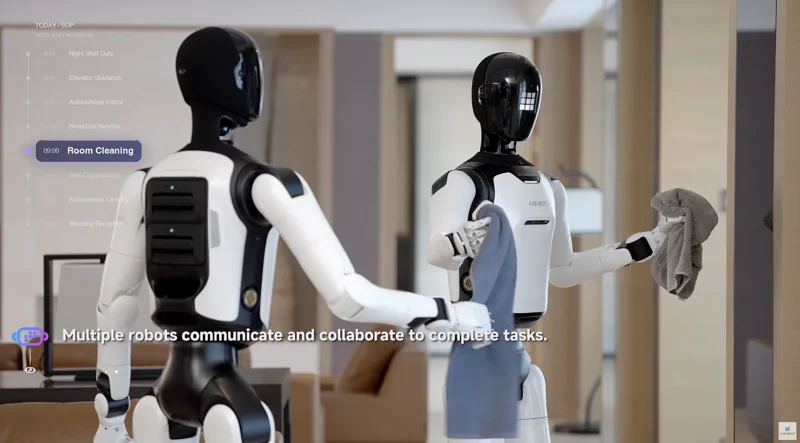
It seems every humanoid robot is destined to endure a slightly cringeworthy adolescent phase. Not long ago, we were watching Agibot’s creations perform martial arts—a flashy, if ultimately pointless, display of agility that we covered in This Humanoid Robots Kung Fu is Better Than Yours . Now, the company’s latest model, the A3 Ultra, appears to have grown up, put on a tie, and started its first graduate scheme in the service industry. In a new video, the robot is seen checking guests into hotels, folding laundry, and even trying its hand at a bit of car salesmanship.
The pivot from kung fu master to hospitality intern is a bit of a gear-shift, but it’s a necessary one. Flashy demos might rack up the views, but folding towels and stacking shelves are the sort of “proper jobs” that will eventually justify a robot’s existence on a balance sheet. Agibot is clearly keen to prove its creation is more than just a lab-bound research project; it’s a prospective employee. And a busy one at that, shown collaborating with other units, navigating lifts, and even plugging itself in for an autonomous top-up.
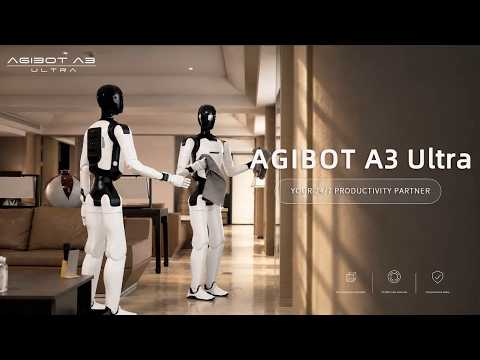
Anatomy of a Working-Class Bot
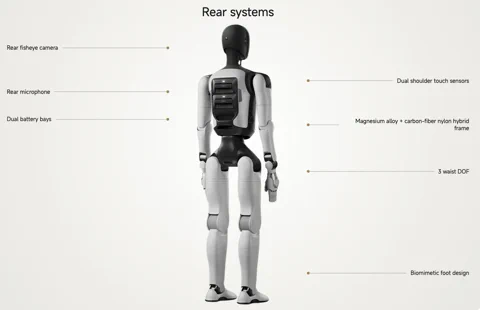
Beneath that sleek, monochrome exterior, the A3 Ultra is a serious bit of kit. Standing 5ft 9in (1.74m) tall and weighing in at 60kg, it’s built on a hybrid frame of magnesium alloy and carbon fibre. This isn’t some flimsy prototype; it’s designed for the daily grind.
The spec sheet is impressive, if a little intimidating:
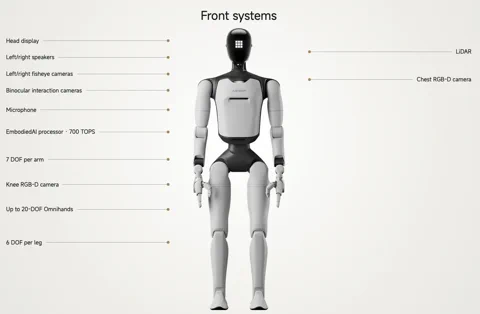
- Degrees of Freedom (DOF): A staggering 51 active DOFs, allowing for a vast range of motion. This includes 7 DOF per arm and 6 per leg, facilitating fluid, human-like movement.
- Manipulation: The hands are the real stars here. Dubbed “Omnihands,” they boast a combined 20 degrees of freedom, enabling delicate tasks and a respectable 5kg payload capacity per arm.
- Perception: The head is bristling with sensors, including a 360° LiDAR system, binocular interaction cameras, and fisheye lenses for a total surround view. Additional RGB-D cameras on the chest and knees help with spatial awareness and dodging obstacles.
- Processing Power: The whole show is run by an “embodied AI” processor delivering 700 TOPS (Trillion Operations Per Second), reportedly built on NVIDIA’s Thor platform. That’s the kind of serious grunt needed for autonomous navigation and task execution without a human tether.
The robot’s power system is also built for the long shift, boasting an 8-hour runtime and the option for either autonomous plug-in charging or a lightning-fast, 10-second battery swap. This is a machine intended to work a full day with minimal faff.
The Price of Productivity is Steep
So, what does it cost to hire this tireless, uncomplaining worker of the future? Brace yourself for some serious sticker shock. According to one US reseller, the Agibot A3 Ultra carries a list price of $89,299 (roughly £68,000).
Let that sink in. While this is likely an early-adopter premium for commercial pilots, it’s a world away from the mass-market figures being teased by the competition. Tesla’s Optimus has a long-term target of $20,000–$30,000, and other players are aiming for a similar bracket to achieve scale. At nearly £70k, the A3 Ultra isn’t a replacement for a minimum-wage worker; it’s a capital investment on par with high-end industrial machinery. The return on investment for folding towels at this price point feels… optimistic, to say the least.
This positions the A3 Ultra squarely in the territory of pilot programmes for blue-chip corporations and research institutions, rather than small businesses. It’s a tool for companies willing to pay a premium to stay on the bleeding edge of automation, but it’s not yet the droid for the masses.
A Crowded Field of Applicants
Agibot, the Shanghai-based outfit founded in 2023 by former Huawei engineers, is moving at a breakneck pace. The company claims to have already entered mass production and shipped thousands of units—a bold claim in a field where many rivals are still counting their deployments on one hand.
The humanoid robot space is rapidly becoming a clash of the titans. Figure, backed by a heavyweight consortium including OpenAI, Microsoft, and NVIDIA, is already trialling bots in BMW factories. Tesla is leaning on its massive manufacturing and AI heritage to bring Optimus to life. Agibot is a formidable challenger, especially with its aggressive production schedule, but it’s up against the biggest names in tech.
The A3 Ultra is a clear signal that the era of purely performative humanoid robots is drawing to a close. The hardware is robust, the software is smart, and the intent is purely commercial. The video shows a robot capable of performing useful, if basic, tasks in a controlled environment. But the gap between a polished promo and the chaotic reality of a busy hotel lobby is vast. For now, the A3 Ultra has an impressive CV, but with an £68,000 salary expectation, it might be waiting a little while for its first real job offer.