For years, the robotics industry has been trapped in a glittering, high-tech purgatory of impressive-but-unprofitable demos. We’ve all seen the footage: humanoids folding laundry (at a glacial pace), pulling a decent espresso (once), or waving at conference-goers with the uncanny, forced enthusiasm of a theme park mascot. But the moment you ask about scaled, profitable deployments, the room usually goes quiet, save for a nervous cough and some muttered apologies about “ongoing pilot programmes.” As we’ve observed before, this is The Robotics Bubble Isn't Demos, It's the Deployment Nightmare .
Enter Dyna Robotics, a firm that appears to have run out of patience with the demo circuit. In a move that has sent an electric shock through the sector, the company announced that its robots haven’t just been “deployed”—they’ve successfully crossed the rubicon of Return on Investment (ROI). Their flagship partner for this new era? Din Tai Fung, the cult-favourite Taiwanese restaurant chain famous for its obsessive precision with soup dumplings and, evidently, its appetite for automation.
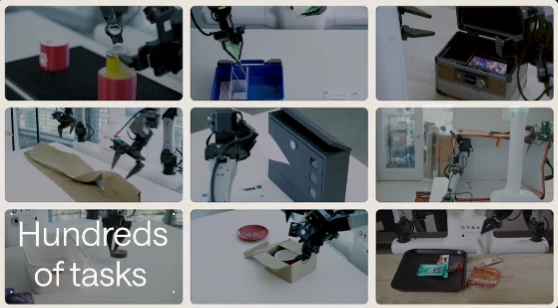
This isn’t just another flashy trial. Dyna is talking about a full-bore rollout across Din Tai Fung’s extensive U.S. network. It’s the opening gambit of a broader strategy to see “hundreds of robots” stationed across hotels, logistics hubs, and data centres by the first half of 2027. They are moving from the sterile safety of the lab to the chaos of the lobby, and they claim to be actually turning a profit for their clients in the process.
The Brains Behind the Bottom Line: Dyna-2
The “secret sauce” enabling this transition from money pit to money maker is Dyna-2, the company’s new “world-action model.” While rivals have been bogged down in the expensive, soul-crushing task of collecting hand-labelled robot data, Dyna took a more audacious—and frankly, more brilliant—path. They fed Dyna-2 a staggering one million hours of human video. That’s roughly 170 years of continuous human experience, a dataset that makes the teleoperation logs of its competitors look like a weekend hobby.
The company claims this colossal video diet has allowed it to uncover several new scaling laws. The most vital? The model’s capacity to understand and interact with the physical world improves predictably the more human video it watches. Crucially, that understanding transfers directly to a robot’s hardware—even a body it has never encountered before. Dyna calls this “cross-embodiment scaling,” and it’s their solution to the industry’s crippling data bottleneck.
“For years, generalist robotics has been stymied by a data bottleneck: collecting physical teleoperation data manually simply cannot scale to general intelligence,” said Jason Ma, co-founder of Dyna Robotics. “Action data is scarce, but video is everywhere.”
By learning from humans performing the mundane choreography of everyday life—cooking, cleaning, assembling—Dyna-2 develops a foundational “physical intuition.” This allows it to master new tasks on new hardware with remarkably little fine-tuning. In one instance, it took just 13 minutes of data for Dyna-2 to teach a five-fingered robotic hand how to unscrew a bottle cap.
From YouTube Videos to Xiao Long Bao
The partnership with Din Tai Fung is the ultimate high-pressure stress test. The chain is an operational marvel; its U.S. locations reportedly rake in an average of $27 million (£21 million) in annual sales per restaurant—nearly double its nearest rival. This is no place for clumsy, temperamental machines. It is a high-volume, frantic environment where efficiency is measured in seconds and perfectly crimped dumplings.
The deployment validates Dyna’s core thesis: a robot brain trained on the breadth of human activity can adapt to specific, commercially valuable labour. The same underlying model that learns to fold a shirt from a video can be tweaked to clear tables, sort ingredients, or manage back-of-house logistics in one of the world’s most demanding hospitality settings. This is where the abstract elegance of a world-action model meets the cold reality of a balance sheet.
Dyna’s Robots-as-a-Service (RaaS) model further sweetens the deal for businesses like Din Tai Fung, binning the intimidating upfront capital expenditure in favour of a predictable monthly subscription.
So, Is the Deployment Nightmare Over?
Steady on with the champagne. While Dyna’s announcement is a refreshing and significant departure from the industry’s demo-heavy narrative, scaling hardware remains notoriously difficult. Supply chains snap, maintenance issues snowball, and the real world has an infinite capacity for generating “edge cases” that no amount of training data can fully predict.
However, Dyna Robotics has decisively shifted the conversation. They’ve built a compelling case that the road to general-purpose robots isn’t paved with millions of hours of painstaking manual instruction, but with the vast ocean of video data that already exists. They’ve moved the goalposts from “Can it do the trick?” to “Does it pay for itself?”
By crossing the ROI threshold with a major, high-profile client, Dyna has thrown down the gauntlet. The pressure is now on the rest of the field to prove that their multi-million-dollar humanoids are more than just incredibly sophisticated science experiments. The age of the demo might finally be drawing to a close, and the era of the profitable, working robot may have just begun. It’s about time.