Nine years. In the time it’s taken Tesla to go from showing off a sleek red Roadster prototype to actually delivering the thing, the world has become a very different place. But after an eternity of delays, “two weeks” memes, and Elon Musk’s elastic relationship with the space-time continuum, the production version has finally landed. And it didn’t just land; it flew, pulled a barrel roll over a Semi, and drove upside down. This isn’t the car we were promised in 2017. It’s something far more absurd—a joint venture with SpaceX that seems hell-bent on making Isaac Newton file a restraining order.
As Musk quipped at the reveal, echoing Peter Thiel: “We were promised flying cars, instead we got 140 characters. Well, not anymore.” The new Roadster isn’t just a car; it’s a statement—a glorious, physics-defying middle finger to the limits of automotive engineering and, perhaps, the final, high-octane hurrah for the human driver.
So, Can It Actually Fly?
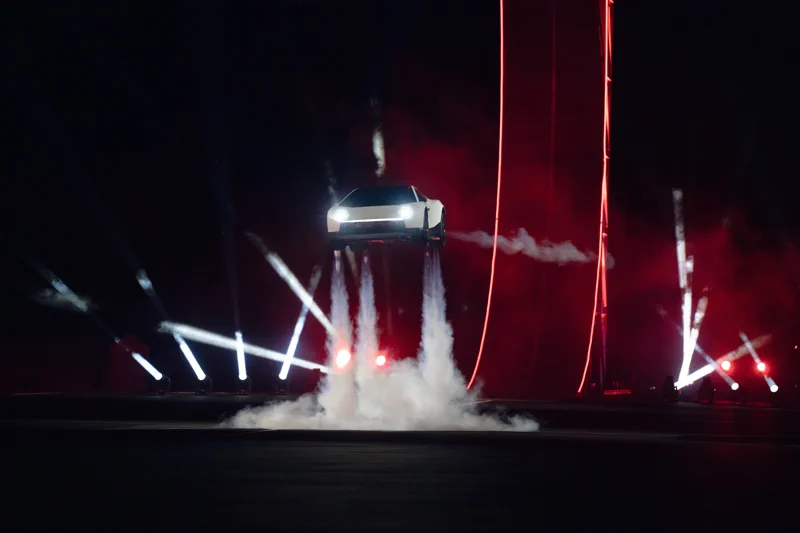
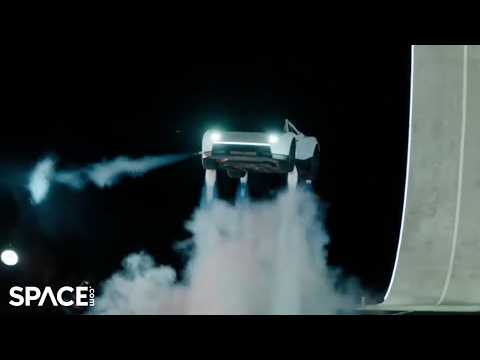
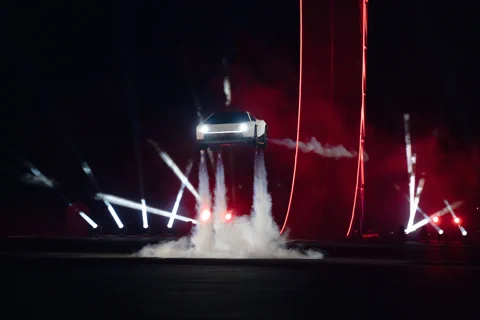
Let’s address the elephant in the room: yes, it “flies.” The top-tier “Rocket” version—an invite-only, single-seater that is spectacularly illegal for road use—uses a perimeter of ten cold-gas thrusters to achieve short, controlled hops, rotations, and stabilization. During a live (and thankfully, autonomous) demonstration, the car launched itself over a line-up of its stablemates—including a Cybertruck and a Semi—performed a “kick-flip” in mid-air, and touched down softly in a plume of compressed air.
This aerial ballet is powered by the “SpaceX Package,” which is less of an optional extra and more of a total personality transplant. The system comes in three distinct flavours:
- Performance: The “base” road-legal model. It still manages a sub-1.6 second 0-60 mph sprint thanks to over 1,340 bhp and a fan-powered ground-effect system.
- Thrust: A limited-release, “track-ready” version that adds rear-mounted thrusters to drop the 0-60 time below 0.9 seconds.
- Rocket: The main event. A single-seat configuration with a full array of ten thrusters, a 600-litre compressed air tank, and a claimed 0-60 mph time of under 0.59 seconds. For all intents and purposes, it’s a land-based spacecraft.
Bending Physics with Air and Suction
The magic here isn’t rocket fuel. The thrusters run on compressed air—stored in carbon-fibre overwrapped pressure vessels tucked into every available nook and cranny—which the car can replenish itself. This system allows the Roadster to generate thrust that completely bypasses the tyres, overcoming the physical limitations of friction that govern every other car on the planet. While the Rimac Nevera dances on the absolute edge of what rubber grip allows, the Roadster simply punches a hole through the ceiling.
But the insanity doesn’t stop there. From the Performance version upwards, the car features a “multi-mode suction system”—a series of fans and seals that actively sucks the air from beneath the chassis. This creates enough downforce to, as demonstrated, hold the car upside down on a curved ramp while completely stationary.
In a surprising twist for the purists, Chief Designer Franz von Holzhausen and VP of Vehicle Engineering Lars Moravy confirmed the new Roadster is rear-wheel-drive only. The tri-motor, AWD layout from the 2017 concept has been binned in favour of two ludicrously power-dense motors on the rear axle. Delivering over a megawatt of power and enabling surgical torque vectoring, the goal was to create “the ultimate driver’s car.” That meant keeping the weight under 1,700 kg and the dynamics raw.
A Mashup of the Entire Tesla Toy Box
The new Roadster is a perfect storm of technologies from across Musk’s empire. The cold-gas thrusters are a direct application of SpaceX’s attitude-control systems used on Falcon 9. That cryptic hint about “Optimus ankle muscles” in the teaser now makes sense: the lightning-fast, all-electric actuators controlling the thrusters and active aero surfaces require the same precision and speed as the joints on a humanoid robot. It’s a clear case of cross-pollination between Tesla’s robotics and automotive divisions.
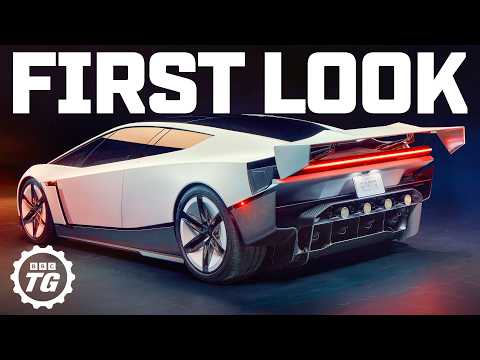
The design language has also evolved, ditching the softer curves of the original prototype for a more angular, aggressive look that nods to the Cybertruck and the classic Lotus Esprit. It looks like it was designed by a car company and a rocket company, which is exactly what it is.
The Last Hurrah for Human Drivers?
There’s a beautiful irony in Tesla—a company relentlessly pivoting toward a future of autonomous robotaxis—building the most extreme, hands-on driver’s car ever conceived. This project feels like a capstone, a final, defiant celebration of human control before the steering wheel is relegated to a museum. As we’ve noted before, the promise of a Translation not available (en-gb) has been a long-running saga. Now, with competitors like BYD making their supercars Translation not available (en-gb) , Tesla had to deliver something that wasn’t just fast, but fundamentally different.
Production is slated to begin “for real this time” in 2028 at Giga Texas. Reservations have reopened, requiring a £40,000 deposit for the Performance model and a staggering £200,000 for the Thrust version. Final pricing remains a mystery. One thing is certain: after nine years of waiting, Tesla has delivered a machine so far beyond the initial promise that it feels less like a car and more like a visitor from a much more exciting future. Just don’t ask your insurance broker about the flight cover.