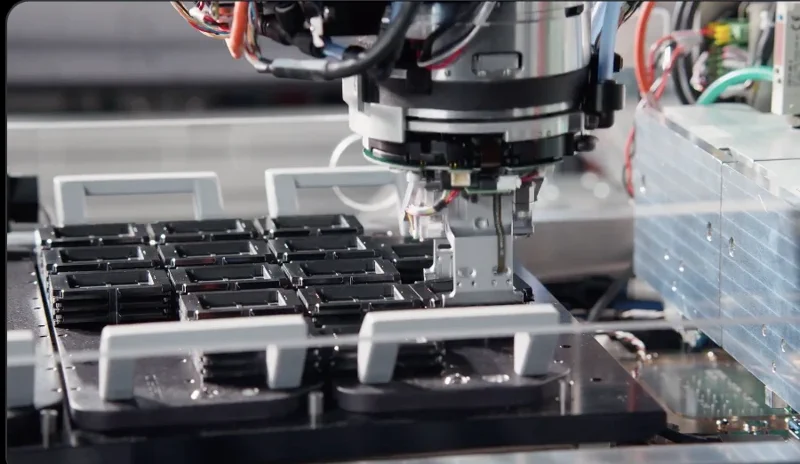
Atomic Machines wants to make manufacturing as fluid as software development: you describe a gadget digitally, and the system builds it without needing a bespoke factory floor for every new iteration. After six years operating in the shadows, the firm unveiled its Matter Compiler this October. Its first tangible proof of concept, the PrimeSwitch PS-150 power relay, transforms that lofty pitch into a component you can actually solder onto a circuit board.
The distinction is vital. A programmable shape is a neat trick, but a functional machine requires moving parts, specific material properties, and predictable physics. According to Atomic Machines’ breakdown of the Matter Compiler, their platform integrates these capabilities into a reusable digital workflow. In theory, a new device should only require a fresh set of instructions, rather than a warehouse full of custom tooling or expensive masks. It’s a bold claim for an industry where the manufacturing process is usually just as complex and bespoke as the product itself.
Closing the loop between AI and the physical world
Founder Jeff Holden describes the project as the missing link between digital design and physical reality. In the company’s manifesto, they argue that generative design is only as good as the manufacturing system’s ability to execute granular tasks and learn from the results. Creating a slick CAD model is just the warm-up; the real challenge is making the atoms behave.
The Matter Compiler is designed to build, measure, and feed those insights back into future designs. The ultimate “North Star” is a prompt-to-product workflow. We aren’t there yet—you can’t just type “make me a toaster” and wait for the delivery—but the ambition is clear. For now, the real benchmarks remain engineering validation, material durability, and the cold, hard reality of repeatable production.

Why lead with a power relay?
The first fruit of this labour is the PrimeSwitch PS-150, an electromechanical relay. Traditional mechanical switches are great conductors but can be sluggish. Semiconductor switches are lightning-fast but come with their own heat losses and isolation headaches. Atomic Machines is aiming for the “goldilocks” zone: rapid switching, ultra-low resistance, and genuine physical separation.
The manufacturer’s published PrimeSwitch specs make for impressive reading:
- 150 A continuous AC or DC current, no active cooling required.
- 200 micro-ohms on-resistance.
- 50 microseconds opening time to 1,500 V galvanic isolation.
- 9.5 mm diameter by 3 mm height, in a standard surface-mount package.
- Bistable operation, meaning it draws zero power to stay in its current state.
It’s worth noting these are the manufacturer’s own figures, not independent lab results. The product is currently listed as available for sampling—a significant milestone, certainly, but a different beast entirely from mass-market adoption or proven economies of scale.
The “General Purpose” litmus test
The PrimeSwitch is a clever opening gambit because it solves a real-world engineering problem. However, the bigger bet is that this same platform can churn out entirely different classes of micro-machines—from mechanical and fluidic components to advanced optics.
The real test will be seeing fundamentally different devices emerge from the same hardware, backed up by solid data on yield, reliability, and throughput. A high-speed relay is a brilliant start, but the dream of a “universal factory” for micro-machines is a much larger mountain to climb. Even when the marketing is this polished, the gap between a single component and a manufacturing revolution is worth watching closely.