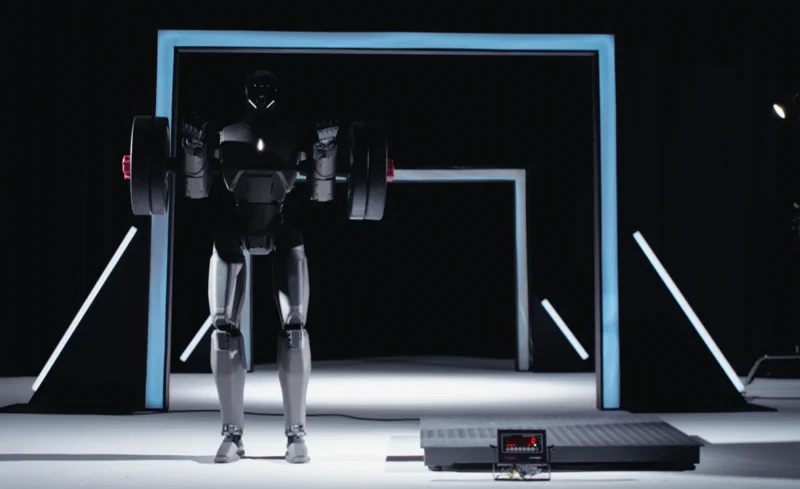
While the rest of the robotics industry remains locked in an unspoken arms race to see whose multi-million-pound biped can fold a polo shirt the least awkwardly or gingerly balance a flat white, San Francisco-based Foundation Future Industries has taken a radically different punt: unapologetic, heavy-duty brute force.
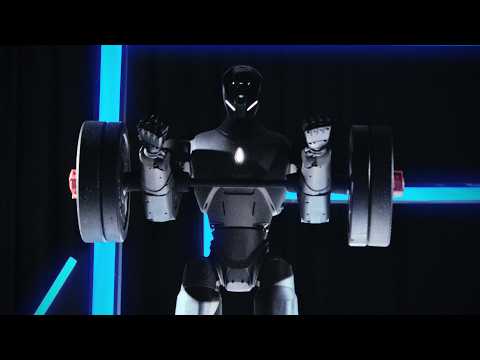
Enter the Phantom Mk2, a six-foot-tall, 84-kg humanoid robot designed not for plush Silicon Valley living rooms, but for the grit, mud, and hazards of heavy industry and active conflict zones. While most commercial humanoids break into a cold sweat attempting to carry modest payloads of 9 to 18 kilograms, the Phantom Mk2 claims a staggering 90 kg (200-pound) close-carry payload whilst actively walking. In raw power-to-weight terms, this machine is engineered to shoulder more than its own physical body weight, laying down an aggressive gauntlet to the dainty chore-bots currently dominating venture capital pitch decks.
The Anti-Barista: Engineering for Mud, Dust, and Heavy Loads
Foundation CEO Sankaet Pathak has never minced words about the company’s ethos. The game was never to construct an uncanny “synthetic human” loaded with existential baggage, but to forge an unyielding industrial tool that tackles brutal, dangerous graft without a murmur of complaint. That mandate dictated a clean-sheet mechanical overhaul for the Mk2.
Standing 6 feet (183 cm) tall and tipping the scales at roughly 84 to 88 kg depending on the kit fitted, the Phantom Mk2 sports 29 degrees of freedom driven by proprietary high-torque cycloidal actuators and field-swappable modular joints. Unlike delicate showroom prototypes that throw a wobbly at the first sign of a puddle, the Mk2 arrives with full IP67 dust and water resistance. It is engineered to keep trundling through torrential downpours, desert grit, freezing sleet, and sweltering heat.
Powering this heavyweight frame is an onboard 3 kWh battery system engineered to deliver 4 to 6 hours of operational runtime under typical workloads. Crucially for round-the-clock factory operations, the battery architecture supports a rapid 30-minute fast charge, keeping downtime to an absolute minimum in settings where every idle second bleeds capital.
Cortex II AI: Imprinting Muscle Memory in Weeks, Not Months
A rugged mechanical chassis without razor-sharp spatial awareness is merely an expensive pile of scrap metal waiting to punch a hole through the nearest partition wall. To pilot the Phantom hardware, Foundation unveiled its second-generation embodied AI system: Cortex II.
Rather than relying on brittle, hand-crafted inverse kinematics or spending months faffing about fine-tuning simulator physics, Cortex II acquires real-world manipulation skills primarily via human imitation learning. Foundation claims the system can ingest human behavioral demonstrations, map the physical constraints, and deploy an entirely new industrial capability in less than a fortnight. In targeted manipulation routines, the firm reports Cortex II can master complex tasks with as few as 60 human demonstrations, marching steadily toward single-shot task assimilation.
The underlying intelligence relies on a dual-engine architecture:
- Reasoning Model: Interprets high-level operational commands in natural language, deconstructing abstract goals into logical, physical sub-routines.
- Embodied World Model: Trained on vast video corpora and real-world physical dynamics (including unstructured sensory play), predicting environmental friction, weight shifts, and force reactions to ensure stable locomotion and unshakeable grip control.
To run these models on the edge without tethering the bot to a remote server farm, Foundation partnered with AMD to bake the Ryzen AI Embedded X100 platform directly into the chassis torso. Pairing “Zen 5” compute cores and RDNA 3.5 graphics with dedicated XDNA 2 neural processing units (NPUs) over unified low-latency memory, the architecture ensures that perception, dynamic balance, and path generation do not blow the robot’s thermal or power budget.
From Factory Assembly Cells to Frontline Logistics
Foundation’s trajectory has parted ways sharply with conventional tech orthodoxy. The company’s earliest iteration, the Phantom Zero, was little more than a pair of actuators strapped to an armless torso. Yet Foundation promptly bolted it inside an active automotive manufacturing cell, running three shifts a day, five days a week. According to company disclosures, Phantom variants have participated in the assembly workflows of more than 24,000 vehicles during extensive field trials.
However, the company’s most controversial and boldest deployments belong squarely in the defence sector. Foundation previously deployed two Phantom MK1 units to Ukraine to evaluate robotic utility in non-combat battlefield logistics, tactical resupply, and hazardous reconnaissance. The unforgiving realities of the front line exposed critical mechanical vulnerabilities, leading directly to the Mk2’s sealed joints, autonomous fall-recovery routines, and reinforced load ratings.
While competitors sign performative pacifist pledges barring their machines from security applications, Foundation has leaned hard in the opposite direction. The startup has openly explored defence roles ranging from subterranean tunnel inspections to forward operating base logistics, arguing that taking flesh-and-blood personnel out of harm’s way is the ultimate humanitarian objective.
Reality Check: Scaling Past the Silicon Valley Hype
Impressive reveal videos and bench-press demos on a slick studio stage are par for the robotics course, but the genuine acid test is commercial economics. Foundation previously indicated that commercial units of its earlier generation commanded an annual lease cost of around $100,000 (£78,000) per robot per year. For heavy industries grappling with acute labour shortages and eye-watering liability claims, that balance sheet maths works out rather well—provided the hardware can endure round-the-clock graft without blowing an actuator every forty-eight hours.
Achieving scale, however, demands serious war chests. With strategic expansion advisers like Eric Trump on board and South Korea’s Base Group exploring a reported $150 million investment alongside a planned manufacturing joint venture in East Asia, Foundation is aggressively gearing up for volume production. The company has slated early commercial production runs for 2027, eyeing an initial capacity of 5,000 robots annually before ramping towards tens of thousands.
Whether Foundation can successfully pivot from jaw-dropping hardware demos to mass-producing battle-hardened industrial bipeds remains to be seen. But in an industry overcrowded with machines designed for an art gallery or a spotless kitchen, the Phantom Mk2 is a deafening, 90-kilo reminder that the real value in robotics often comes covered in hydraulic grease, dust, and sheet metal.