If you ever fancy watching an industrial engineer break into a cold sweat, whisper the phrase “high-mix outbound case palletising” into their ear. For decades, the standard procedure for getting pallets loaded with completely mismatched boxes out of the door involved human workers destroying their lumbar spines, or massive, multi-million-pound sorter loops gobbling up half a warehouse footprint. Japanese robotics trailblazer Mujin has spent years preaching that machine intelligence can replace both brute human force and bloated conveyor infrastructure. With its latest deployment at Green Logistics Co., Ltd. in Japan, that gospel is facing its sternest real-world test yet.
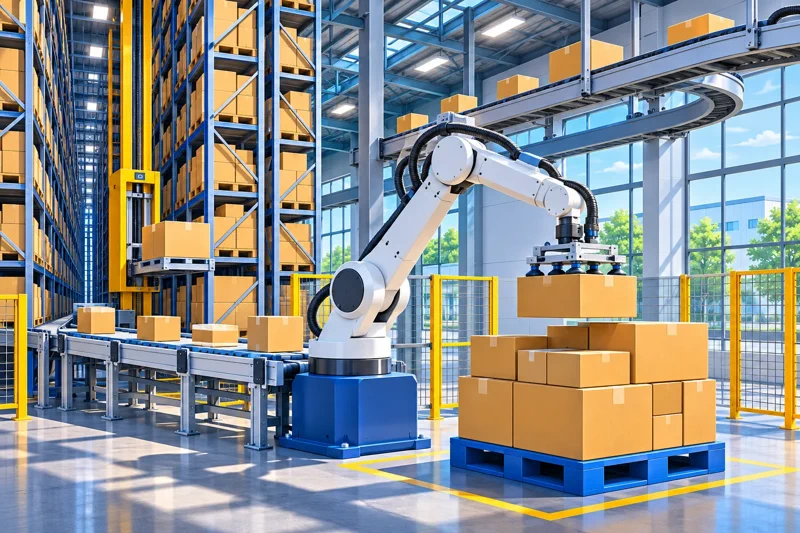
Mujin’s case study outlines six palletising cells at Green Logistics’ new distribution centre in Hyōgo, Japan. Rather than routing boxes through labyrinthine intermediate buffer conveyors, these six robotic arms interface directly with an automated storage and retrieval system (AS/RS). The system plucks individual shipping cartons, calculates optimal load stability on the fly, and constructs dense, mixed-SKU pallets for dispatch—all without a single line of hardcoded trajectory programming.
Bypassing the Multi-Million-Pound Sorter Loop
In conventional warehouse automation, robots adore monotony. Feed an articulated arm a single pallet of identical detergent jugs, and it will happily stack them until its bearings grind to dust. The moment you ask that same arm to handle a fragile shoe box, followed by an 18-kilogramme crate of tinned goods, followed by an awkwardly shaped bundle of kitchen roll, standard automation collapses into an existential crisis. To manage this variability, legacy automated warehouses typically install sprawling sorting loops that marshal, sequence, and buffer inventory before feeding it to specialised stations.
The Green Logistics deployment takes an axe to that architectural bloat. By linking the six robotic picking cells straight to the outbound AS/RS feeds, Mujin has effectively binned the need for a dedicated pre-sorting loop. Inventory arrives in mixed sequences directly from high-density storage, and the robotic cells solve the three-dimensional jigsaw puzzle right at the pallet deck.
Cutting out intermediate sorting hardware does far more than claw back precious warehouse floor space; it strips away dozens of moving mechanical components, transfer points, and potential single points of failure. The trade-off, of course, is that the cognitive burden shifts entirely onto software and machine vision.
Physical AI and Arm-Mounted Vision at Scale
At the core of the installation sits MujinOS, the software platform originally architected by roboticist Ross Diankov and business partner Issei Takino. Rather than relying on traditional teach pendants—where human technicians manually record waypoints for every single twitch and turn—Mujin leans on real-time kinematic planning and a continuously updating digital twin.
To squeeze the installation into a tight operational footprint, the engineers mounted the 3D perception hardware directly onto the robotic arms themselves, rather than suspending bulky camera gantries overhead. This arm-mounted vision approach brings distinct engineering perks to the table:
- High-Density Cell Architecture: Eliminating external sensor rigs and overhead trusses allowed Green Logistics to pack all six cells into a remarkably compact footprint adjacent to the AS/RS discharge bays.
- Dynamic 3D Scanning: The arm positions its camera directly above the pick and place zones, sizing up the position and orientation of incoming cartons in an instant.
- Catalog Breadth: Mujin confirms that the vision model actively recognises and handles approximately 1,000 distinct carton varieties.
- Dynamic Trajectory Calculation: The motion planning engine calculates placement positions and robot paths entirely on the fly.
Instead of guessing where a box should sit based on a static blueprint, the system calculates load stability, centre of gravity, and downstream transit durability dynamically. Heavy, rigid cartons form the baseline structural walls, whilst lighter or fragile parcels are sequenced on top—the precise brand of spatial common sense that stops cereal boxes from ending up squashed beneath five-litre tubs of motor oil.
The Cold, Hard Throughput Maths
Palletising software demos always look utterly seamless in controlled trade show environments, but logistics directors live and die by cartons per hour. According to Mujin’s published case study, the operational numbers at Green Logistics stack up as follows:
- Per-Robot Throughput: Mujin quotes a capacity per robot of approximately 500 cases per hour.
- System-Wide Output: Across all six synchronised cells, total outbound capacity hits roughly 2,500 cases per hour.
- Labour Reduction: Mujin reports an estimated 33% reduction in picking and handling labour compared to previous manual operations.
- No sprawling sequencing unit: The cells perform mixed-case palletising without a dedicated upstream sequencing system.
Shaving a third of the labour off an outbound dispatch dock is a massive triumph in Japan, where logistics operators are running headlong into brutal demographic realities. Between a rapidly greying population and strict caps on lorry driver overtime, distribution centres nationwide face a staffing deficit that throwing money at simply will not fix.
The Economic Realities of “Teachless” Robotics
While the operational metrics from Green Logistics paint a compelling picture of Physical AI out in the wild, warehouse operators scrutinising the announcement will be keeping a hawkish eye on total cost of ownership. High-mix robotic palletising remains one of the most capital-intensive upgrades a 3PL can possibly sign off on.
Mujin has not publicly disclosed the turnkey installation price tag, maintenance contracts, or the exact payback timeline for the Hyōgo facility. A reduction in required shifts does not automatically translate into a frictionless drop in overall operational expenditure. Meanwhile, sophisticated robotic end-effectors—especially multi-axis vacuum grippers grappling with unpredictable, battered corrugated cardboard—require relentless preventative maintenance and bulletproof uptime validation over thousands of gruelling shifts.
Furthermore, direct AS/RS integration creates a razor-thin margin for error: if an automated crane jams or the software bridge stutters, the robotic picking cells are starved of work; conversely, if a cell grinds to a halt over an unrecognisable crumpled parcel, upstream bottlenecks can cascade right back into the high-bay racking in minutes. How gracefully Mujin’s digital twin navigates messy real-world exceptions without requiring an engineer to dash onto the gantry will dictate whether this blueprint takes off across the wider logistics sector.
Out of the Lab, Onto the Loading Bay
For years, industrial automation vendors promised an era of lights-out warehousing where machines could see, adapt, and make spatial decisions without months of painstaking manual commissioning. The Green Logistics deployment shows that software-defined physical automation is finally emerging from its awkward adolescence. Moving mixed cartons straight from automated storage onto outbound pallets proves that teachless, vision-guided robots are ready for the industrial heavy lifting.
As global supply chains brace for chronic labour shortages and relentless e-commerce SKU proliferation, the warehouses that survive will be the ones that replace rigid, room-sized conveyor monoliths with agile, intelligent arms. Green Logistics has put six of them to work; don’t be surprised if the rest of the industry swiftly follows suit.