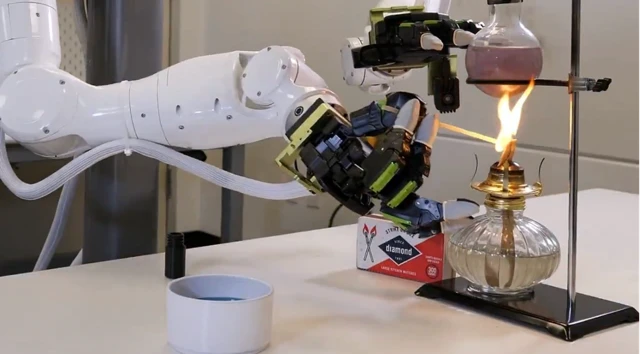
Prometheus brought fire to mankind and was punished for eternity. NVIDIA has just taught a robot to do the same, presumably for a tidy Q3 earnings boost. The company’s Generalist Embodied Agent Research (GEAR) lab recently released a video of its GR00T-2 project, and it’s a masterclass in unsettlingly precise manipulation. We aren’t looking at a clumsy automaton fumbling with wooden blocks; this is a bimanual robot arm striking a match, lighting a spirit burner, and wielding scissors with a steadiness that your coffee-addled human hands could only dream of.
For years, the robotics industry has been stumped by the “last-mile problem” of dexterity. We have robots that can hoist cars and navigate sprawling warehouses, but ask one to thread a needle or plug in a USB cable, and you might as well be asking it to explain the nuances of postmodern literature. This is why the GR00T-2 demonstration is so compelling. It is a direct assault on the fine-motor-skill barrier, showcasing a level of finesse that moves robots closer to being truly general-purpose tools rather than glorified single-task machines.
The Brains Behind the Brawn
The real wizardry here isn’t just the custom, low-cost hardware; it’s the AI model pulling the strings. GR00T-2 is what NVIDIA calls a world-action model (WAM), a significant step beyond the vision-language-action (VLA) models that have recently dominated the field. Instead of merely predicting the next action, GR00T-2 predicts future video frames and the actions that lead to them. In essence, it’s developing a model of physical consequence—an intuition for how its movements will actually alter the world around it.
This model was trained on a colossal and diverse dataset: over 400,000 hours of first-person human video, supplemented by tens of thousands of hours of robot teleoperation data. This “cross-adaptation” approach, dubbed X-Adapt, allows the robot to learn skills by watching humans, even if it has never physically performed the task itself. For example, GR00T-2 learned to prepare a filter paper in a lab funnel with a 65% success rate simply by observing human videos.
The results are startlingly effective. Out of the box, with zero task-specific demonstrations, GR00T-2 could complete 40 out of 50 evaluated tasks at least once. With just a single demonstration, its average success rate jumped to 71%. Give it five demonstrations—less than three minutes of data per task—and that figure skyrockets to 95% after a brief fine-tuning session.
From the Lab to the Factory Floor
While lighting matches makes for a cracking party trick, NVIDIA and its partners have more practical applications in their sights. The dexterity shown by GR00T-2 is crucial for tasks in manufacturing, logistics, and even hospitality. The ability to handle deformable objects like cables and cloth—a new feature enabled by the updated Isaac Lab 3.0 simulation platform and its Newton physics engine—opens up a new frontier of automation.
Industry giants are already taking note. Foxconn is applying GR00T-2 to automate server manufacturing, while Siemens is evaluating it for a range of industrial uses. Another company, Nexuni, is even testing the model for the Sisyphean task of robotic laundry handling. These aren’t just academic experiments; they are tangible steps toward deploying generalist robots in complex, real-world environments.
This push is part of NVIDIA’s broader strategy to become the central nervous system for the entire robotics industry. By providing the foundation models (GR00T), the simulation environments (Isaac Lab), and the onboard computers (Jetson Thor), the company is building an ecosystem designed to accelerate the development of autonomous machines.
An Unsettling Glimpse of the Future
So, is this the “ChatGPT moment” for robotics that CEO Jensen Huang predicted? Not quite, but the fuse has certainly been lit. The combination of increasingly sophisticated foundation models, hyper-realistic simulation, and the ability to learn from vast, non-robot data sources is creating a feedback loop of rapid progress.
The GR00T-2 demonstration is more than just an impressive technical showcase; it’s a statement of intent. It shows that the major bottleneck in robotics is shifting from hardware to software—from bespoke engineering to scalable AI. For now, GR00T-2 is just lighting lab equipment on fire under controlled conditions. Tomorrow, it might be assembling your electronics, sorting your parcels, or even—heaven forbid—correctly folding a fitted sheet. Now that would be a breakthrough worth watching.