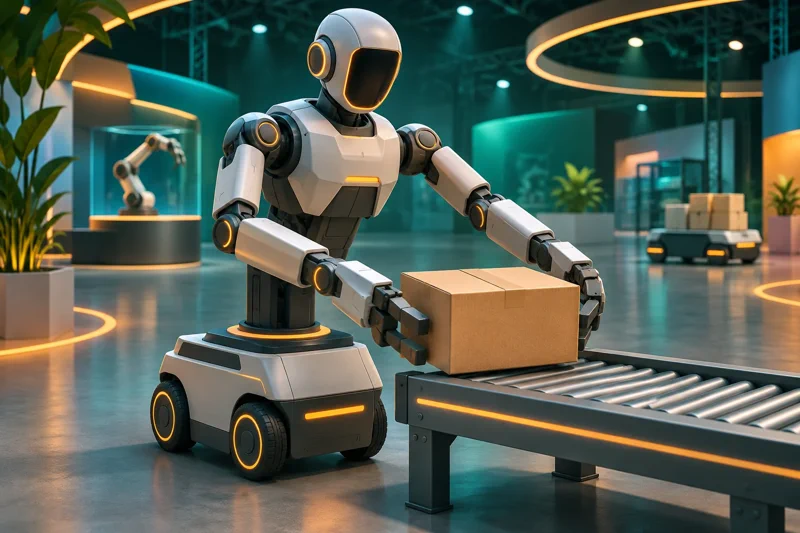
Humanoid robotics demonstrations routinely suffer from an acute case of theatrical staging: flattering lighting, suspiciously compliant props, and a nervous engineer lurking just off-camera, gripping an emergency stop button like a string of rosary beads. That is precisely why RobotEra’s appearance at the 2026 Asia-Pacific Economic Cooperation (APEC) CEO Summit in Shenzhen ruffled feathers for all the right reasons. Rather than rolling out an android to wave stiffly at global dignitaries or break into canned, algorithmic breakdancing, the Tsinghua University spin-out wheeled out its M7 upper-body humanoid for an uncompromising live parcel sorting demonstration.
Shuffling cardboard cartons may well lack the cinematic swagger of a backflipping biped, but in the cutthroat margins of modern logistics, relentless, high-throughput manipulation is the actual holy grail. RobotEra earned an invitation to the APEC CEO Summit for the second year on the trot—a rare feat for an embodied-intelligence outfit. Founder and CEO Jianyu Chen used his keynote at the APEC Finance Night, titled “Putting Robots to Work at Night,” to deliver an unabashedly pragmatic message: while Western laboratories tie themselves in philosophical knots over general-purpose artificial intelligence, Chinese industry is busy putting cold, uncomplaining steel on the graveyard shift.
Beyond the Sanitised Lab Demo: The M7 Platform
The machine at the heart of the showcase is the RobotEra M7, a purpose-built upper-torso manipulation platform engineered to ditch the battery-draining vanity of bipedal balance when all that is required is graft at a sorting bench.
By ditching legs for a mobile wheeled base, the hardware funnels every ounce of power and compute into reach, dexterity, and conveyor-side parcel handling. The wheels cart the rig between bays, leaving the twin manipulators to do the donkey work along the belts. RobotEra maintains an open footprint by sharing portions of its foundational research on GitHub, though clear-eyed observers will know to judge open-source code and factory-floor logistics hardware on entirely separate merits.
The Numbers Game: 1,500 Parcels Per Hour
According to a separate deployment update with China Post, RobotEra’s systems are already embedded across 11 postal hubs in eight cities throughout Guangdong province. During an initial trial at the Guangzhou Postal District Centre, the company clocked a sustained induction rate north of 1,500 parcels an hour. While that figure specifically details loading cartons onto active sorting belts during the postal rollout, RobotEra stayed coy about the exact hourly throughput achieved during the live summit demo itself.
RobotEra claims the postal setup seamlessly spits out irregular items and throttles its pace on the fly. However, the release stops short of disclosing mean-time-between-failures, intervention rates, or independently verified uptime across those 11 facilities. Those missing data points are precisely what any hard-nosed logistics director would demand before signing off on swapping human teams for an autonomous night shift.
Moving Beyond Parlour Tricks to Industrial Muscle
For three solid years, the robotics sector has been up to its neck in over-produced sizzle reels: bipedal marvels pouring flutes of champagne, gingerly folding a single towel at glacial speed, or pulling off kung-fu poses to game the social media algorithms. But the sharp end of industrial automation does not care a jot whether your robot can do the tango. The real test is whether it can spot a battered Jiffy bag, snatch it up without popping the contents, register the barcode, and chuck it onto the belt flawlessly for eight hours straight.
By turning up at APEC with the unglamorous M7 to sort boxes instead of peddling tech-diplomacy theatre, RobotEra laid its cards firmly on the table. The frontline of embodied AI has left the sanitised simulation rig behind and pitched up on the depot floor. If these postal trials can convert their headline throughput into dependable, unbroken shifts, the rest of the humanoid brigade will need to bin the stage choreography and finally clock in for real work.