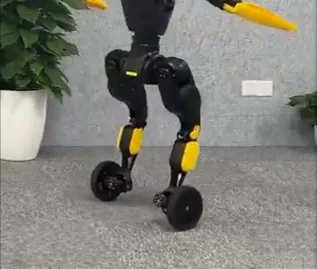
In a move that’s either the dawn of a brand new industrial age or the rather unsettling beginning of a recursive loop we’ll all eventually regret, the Kepler K2 humanoid robot has officially clocked in for its “internship.” Its new workplace? The Phase III digital factory of SUZHOU VEICHI Electric Co., Ltd., a bona fide titan in industrial automation. The K2’s job spec reads like a veritable laundry list of factory floor drudgery: assembly, packaging, sealing, and warehousing. The truly meta twist in this tale? It’s diving headfirst into the full production workflow, which, one presumes, includes knocking out a few of its own kind.
Standing a respectable 5ft 10in tall, the K2 from Kepler Robotics Co., Ltd. is no lightweight, boasting 52 degrees of freedom and the muscle to handle some serious payloads. Yet, in a moment of truly inspired, if utterly baffling, inefficiency, videos capture it dutifully picking up a handheld barcode scanner. One can’t help but wonder why a machine brimming with advanced visual sensors and cutting-edge AI feels the burning need to LARP as a human cashier from, say, 1998. It’s a spot-on illustration of the current state of humanoid robotics: jaw-dropping feats of engineering often hobbled by the sheer insistence on shoehorning them into human-centric processes, complete with all our decidedly clunky tools.
This, naturally, shoves a broader, almost philosophical, question right into the spotlight of robotics design. Why on earth would you build a hyper-dexterous humanoid only to then make it clutch a bog-standard screwdriver? The prevailing wisdom for many in the field is to simply slot these mechanical marvels directly into environments explicitly built for humans. But this, dare I say, rather elegantly sidesteps the potential for far more efficient, purpose-built designs. Instead of a robot that can use a tool, surely the next logical leap is a robot that is the tool—imagine integrated drivers where its fingertips might be, or precision welding torches sprouting from its thumbs. For now, it seems we’re rather stuck in a transitional phase where our bipedal colleagues are still learning the ropes, one ergonomically questionable gadget at a time.
Why Is This Important?
The deployment of the Kepler K2 at VEICHI is more than just another factory automation pilot; it’s a cracking demonstration of a closing loop where robots begin manufacturing the next generation of robots. This could dramatically turbocharge the production and deployment of automated systems, potentially driving down costs and nudging us ever closer to the long-theorised concept of self-replicating manufacturing. While the sight of a robot painstakingly using a barcode scanner is, let’s be honest, comically inefficient, it nonetheless signifies a critical, if wonderfully awkward, step. It shows that humanoids are finally moving from being mere lab curiosities to bona fide “colleagues” on the assembly line, warts and all. The age of the blue-collar robot is officially clocking in.