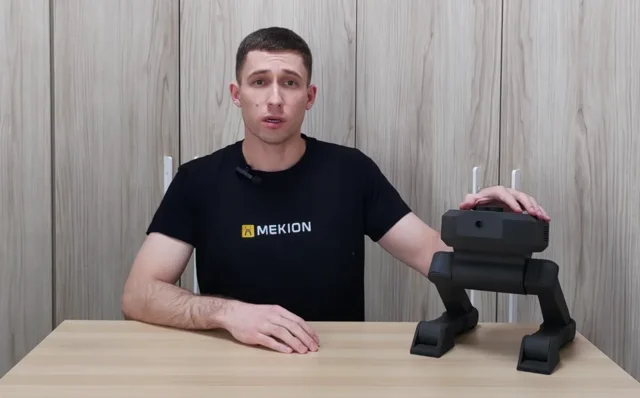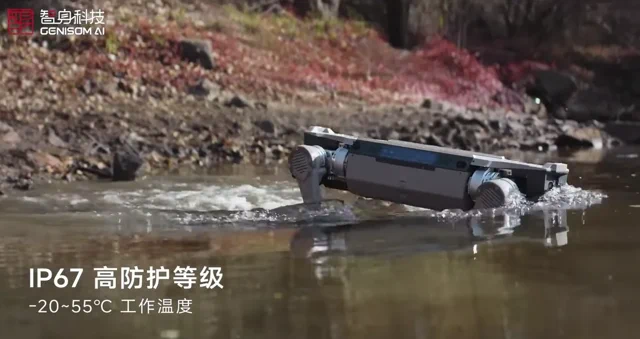
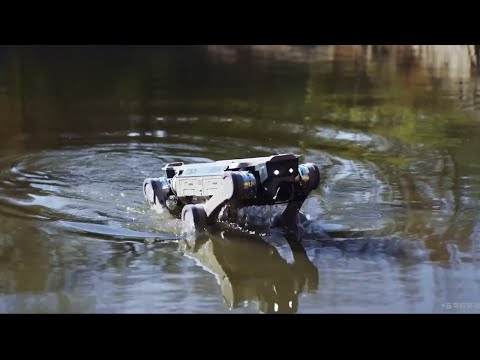
Blimey, another week, another utterly bonkers-yet-brilliant robot dog has popped up from China’s relentlessly competitive robotics scene. This time, it’s the Genisom AI “Tongchui M1,” a quadruped that not only walks, trots, and throws some rather questionable shapes on two legs, but can also go for a proper dip. The M1 is being touted as the first all-terrain amphibious robot dog, and it looks ready to tackle the sort of grotty jobs no self-respecting human would touch with a bargepole.
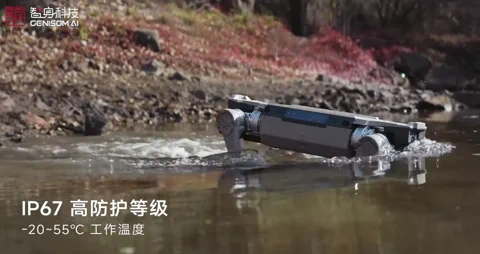
Billed as an industrial workhorse, destined for the grimiest of environments, the M1’s spec sheet seems to back that up with a vengeance. It boasts a full IP67 rating, making it as dust-tight as a sealed biscuit tin and capable of being submerged in water without batting a mechanical eyelid. This plucky bot operates in temperatures ranging from a chilly -20°C to a scorching 55°C (that’s -4°F to 131°F for our friends across the pond, just in case you were wondering). Weighing in at 35kg, it can haul a payload of 30kg, an impressive payload-to-weight ratio that puts it in a league entirely of its own, no two ways about it.
Versatility, it seems, is the M1’s ace in the hole. Genisom AI has equipped it with a dual-battery hot-swap system for continuous operation – because nobody wants a robot conking out mid-mission – and the rather clever ability to switch between traditional feet and wheels for a bit more zip on smoother surfaces. With 360-degree sensing from LiDAR and wide-angle cameras, plus the knack for clearing obstacles up to 80cm high, it’s designed to navigate complex industrial sites with or without a human operator. Essentially, it’s got eyes in the back of its head and a spring in its step, ready for anything.
Why This Matters
The Genisom M1 is another stark reminder of the blistering pace of innovation—and aggressive iteration—in the quadruped market. While some companies pioneered the form factor, others are now rapidly adding specialized, industrial-grade features like amphibious operation. This isn’t just about churning out another viral sensation of a robot doing the Macarena; it’s about building a practical, ruggedised tool for industries like emergency response, infrastructure inspection, and environmental monitoring. In these fields, a robot that can’t be stopped by a mere puddle (or, let’s be honest, a small lake) is a cracking, and potentially rather lucrative, advantage. It’s the difference between a flashy demo and a proper bit of kit that gets the job done, come hell or high water.