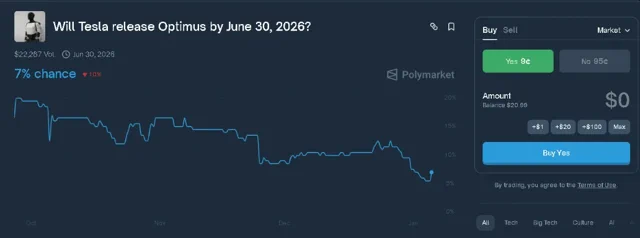
The smart money—or at least the money bandied about on prediction site Polymarket—is currently giving Tesla, Inc.’s Optimus humanoid a paltry 6% chance of being available for consumer purchase by June 30, 2026. The market’s rules are as clear as day and twice as unforgiving: no namby-pamby internal factory deployments, no ’exclusive’ enterprise pilots – just a bona fide, publicly available robot with a live checkout button, thank you very much. This measly sliver of confidence, however, flies squarely in the face of a manufacturing operation that appears to be gearing up for an all-out robot war.
The hype had reached a proper fever pitch back in October 2025, fuelled by widespread whispers of a colossal $685 million order for linear actuators, allegedly placed with Chinese supplier Sanhua Intelligent Controls—a deal supposedly large enough to churn out 180,000 robots. This juicy tidbit sent Sanhua’s stock soaring faster than a rocket-powered teapot, and it certainly suggested the robot’s V3 design was all sorted and ready for the big time of mass production. There was just one teensy-weensy snag in that blockbuster story, however: Sanhua promptly poured cold water on the whole affair, officially denying it and issuing a rather terse statement that it had ’no material information to disclose'.
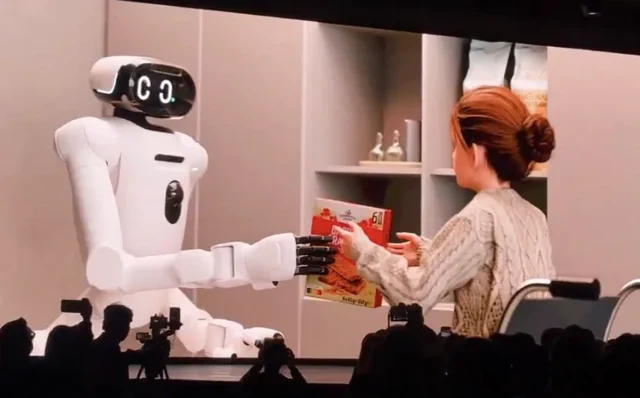
While that particular rumour was well and truly squashed like a rogue spider, the underlying buzz of activity is, apparently, very much real. Indeed, in its Q3 2025 update, Tesla itself confirmed that the “first generation production lines for Optimus are being installed in anticipation of volume production.” Not to be outdone, CEO Elon Musk also tantalisingly teased the unveiling of a “quite remarkable” Optimus V3 prototype for the first quarter of 2026 – a machine he boldly claims will look so eerily real “you’ll need to poke it to tell it’s a robot.”
Why is this important?
The gaping chasm between Tesla’s soaring production ambitions and the market’s rather healthy dose of skepticism truly highlights the monumental, frankly staggering, difference between an industrial workhorse and a shiny consumer product. While Musk might be dreaming of legions of Optimus units toiling away in his own factories, external customer deliveries aren’t exactly expected to hit warp speed. We’re talking late 2026 at the earliest, and even then, they’ll be exclusively for other businesses, not your nan’s living room. A robot destined for the general public, however, requires a level of safety, reliability, and software polish that is, frankly, orders of magnitude harder to nail down than a greased pig at a country fair.
Furthermore, Tesla’s rather storied history of “production hell” and repeatedly delayed timelines for much-hyped products like the Cybertruck and Full Self-Driving capabilities tends to give even the most rational observers a moment of serious pause for thought. Musk’s targets are, as ever, positively astronomical—projecting an eventual capacity of 10 million units annually from Giga Texas, bless his cotton socks—but more grounded forecasts suggest that churning out just a few thousand units in 2026 would be a far more plausible scenario.
Meanwhile, the competition, bless their speedy little circuits, isn’t exactly twiddling its thumbs. Chinese robotics firm UBTECH has already got its rather impressive Walker S industrial humanoids well and truly deployed on the assembly lines of automotive manufacturers. The company plans to scale production to a hefty 10,000 units annually by 2026, effectively proving out the industrial use case while Optimus is still, shall we say, running drills inside Tesla’s very own walls. The prediction markets aren’t exactly betting against Optimus eventually getting its act together in a factory; oh no, they’re simply betting it won’t be waltzing into your living room with a cuppa anytime soon. And given Tesla’s rather colourful track record, that sounds like a jolly sensible wager.