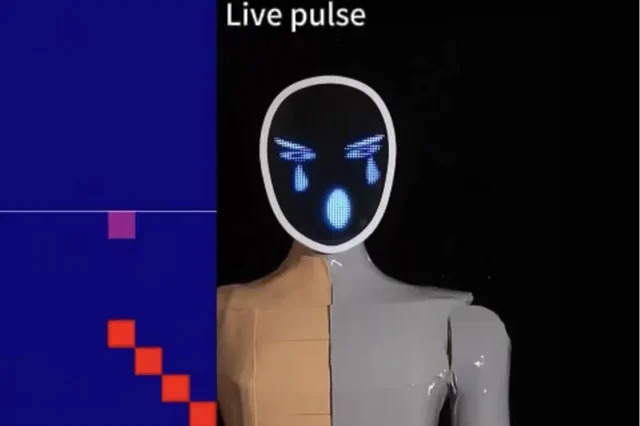
In what sounds like a rather thoughtful, albeit slightly concerning, housewarming gift for our impending robot overlords, a crack research team has gone and developed an electronic skin that bestows upon our metallic mates the ability to feel pain and react with a truly human-like reflex. Researchers from the City University of Hong Kong laid out the nitty-gritty of their “neuromorphic robotic electronic skin” (NRE-skin) in a paper published in the Proceedings of the National Academy of Sciences (PNAS). Unlike those rather basic e-skins of yore, which were little more than glorified pressure sensors, this spanking new bit of kit mimics the human nervous system to conjure up a genuine sense of touch and, crucially, a self-preservation instinct.
The system, one must admit, is devilishly clever. It continuously sends out weak electrical pulses, a sort of constant “all clear” signal to the robot’s central processor. Should the skin suffer a nasty cut or a spot of damage, that signal is immediately interrupted, instantly pinging the robot with the precise location of its boo-boo. But the real party trick, the absolute showstopper, is its pain reflex. When an external force—be it a sharp prod or a blast of excessive heat—surpasses a predetermined threshold, the e-skin doesn’t faff about waiting for the CPU to crunch the numbers. Instead, it fires off a high-voltage signal directly to the robot’s motors, triggering an instantaneous retraction, much like a human yanking their hand away from a scorching hot hob.
As if that weren’t enough to make you spill your Earl Grey, the engineers have also cracked the perennial nut of robot maintenance. The skin is entirely modular and attaches with a satisfying magnetic click. If a section takes a knock, there’s no need for a squad of specialists and a three-week repair backlog. You can simply pop off the damaged piece and snap on a fresh one, rather like a morbidly futuristic LEGO set.
Why Is This Important?
Giving robots the capacity to feel pain isn’t some twisted exercise in making them suffer for our amusement, mind you. No, it’s a absolutely critical safety feature for a future where humans and robots will be rubbing shoulders in unpredictable environments like our homes, hospitals, and bustling public spaces. A robot that can instinctively recoil from potentially damaging situations is a robot that’s far less likely to do itself in or, more crucially, cause a bit of a kerfuffle with the flesh-and-blood folk around it. This takes us way beyond mere obstacle avoidance and into a more embodied intelligence, paving the way for safer, more reliable machines that can finally be trusted to venture outside the carefully controlled confines of a factory floor.