In a move that screams “the future is here and it finally has a decent signal,” the Beijing Humanoid Robotics Innovation Center has successfully demonstrated its Tiangong humanoid robot performing tasks while controlled entirely via a low-orbit satellite link. This marks the first time a humanoid robot has ditched the patchy comfort of terrestrial Wi-Fi and 5G to phone home from the field, proving that our bipedal friends are officially ready to embrace the “work from anywhere” lifestyle.
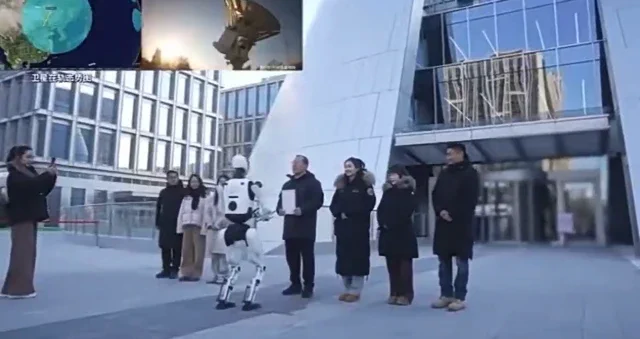
The demonstration, which unfolded at a recent commercial space industry event in Beijing, saw the Tiangong robot calmly retrieve a document from an autonomous WeRide Robotaxi. The entire operation—including the robot’s precise movements and a 720p live video feed from its perspective—was beamed in real-time to a command centre via a GalaxySpace internet satellite orbiting hundreds of kilometres above. The test confirms that complex, remote operations are now perfectly viable even when the safety net of ground-based infrastructure is completely absent.
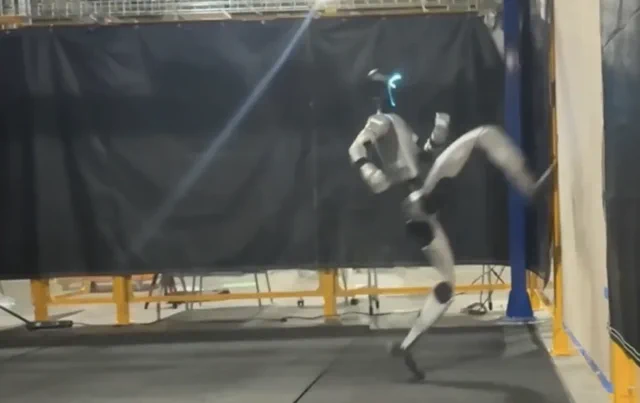
Standing at 5ft 4in (163 cm) and weighing in as a fully electric powerhouse, the Tiangong was first unveiled in April 2024. While it’s capable of a steady 6 km/h trot, this latest milestone isn’t about its sprinting speed; it’s about its reach. By cutting the cord to local networks, the robot is theoretically capable of operating in any corner of the globe, provided it has a clear view of the sky.
Why does this matter?
This successful trial is less about a robot fetching a piece of paper and more about fundamentally tearing up the rulebook for autonomous systems. Until now, the primary bottleneck for deploying advanced robotics in the real world has been the desperate need for stable, high-bandwidth communication. By routing control and data through a low-orbit satellite constellation, the Beijing team has effectively erased “network dead zones” from the equation.
This opens the floodgates for deploying humanoid robots in scenarios that were previously considered a lost cause: inspecting pipelines in the middle of the desert, assisting search and rescue teams in disaster zones where the masts are down, or performing grit-and-gears maintenance on offshore rigs and remote mines. It is a massive step towards a world where robotic assistance isn’t just confined to the sterile, polished floors of a lab or factory, but can be dropped into the messy, unpredictable, and disconnected parts of the world where it’s needed most.