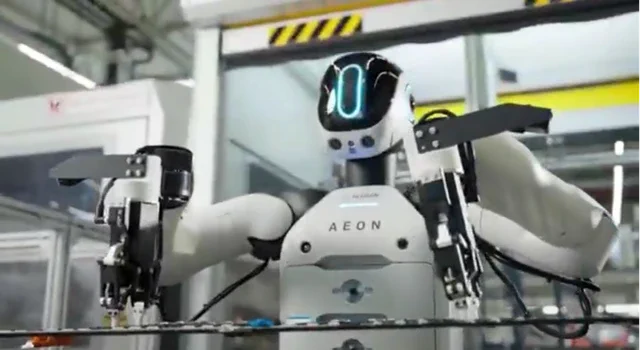
In a move that’s sent a ripple through the industry, Bayerische Motoren Werke AG (BMW) has announced it is deploying humanoid robots across its European production lines for the first time. However, it’s not the two-legged bot you might be expecting. The German car giant is kicking off a pilot programme at its Leipzig plant with Hexagon’s AEON robot, specifically targeting the high-stakes world of high-voltage battery and component assembly. This decision comes just over a year after BMW’s high-profile partnership with Figure AI, Inc. to bring bipedal humanoids to its US facility.
This development adds a fascinating layer to BMW’s automation playbook. The original agreement with Figure AI, inked in January 2024, was destined for BMW’s sprawling manufacturing hub in Spartanburg, South Carolina. That deal was widely hailed as a watershed moment for general-purpose humanoids in the automotive sector. Yet, the Leipzig pilot proves that BMW isn’t putting all its robotic eggs in one basket. The German facility is a crown jewel in their network, churning out the BMW 1 and 2 Series, the MINI Countryman, and up to 300,000 high-voltage batteries every year.
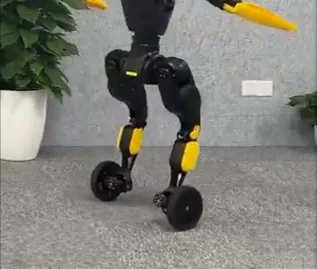
So, what exactly is the AEON robot? While it carries the “humanoid” label, it’s more of a pragmatic, industrial cousin to the walking machines from Figure or Tesla. Developed by the Swedish tech powerhouse Hexagon AB, AEON stands 5ft 5in tall, weighs 60kg, and glides on wheels rather than trekking on legs. It’s a mobile manipulator built for the grit of the factory floor, capable of lugging a 15kg payload and even performing its own battery swaps for virtually non-stop operation. Think less “sci-fi butler” and more “exceptionally capable factory hand on a self-balancing scooter.”
Why does this matter?
BMW’s two-pronged approach suggests a shrewd, if slightly complex, strategy for robotic integration. Rather than tethering itself to a single humanoid platform, the manufacturer is A/B testing different solutions across different continents and, crucially, for different roles. While the Figure pilot in the US is a deep dive into general-purpose AI and bipedal movement, the AEON pilot in Germany is laser-focused on structured logistics and assembly tasks.
It’s a clear signal that the “invasion” of humanoid factory workers won’t be a uniform takeover. Instead, we’re likely looking at a fragmented ecosystem where specialised, wheeled “humanoids” like AEON handle the heavy lifting of logistics, while more advanced bipedal robots are gradually introduced to complex, human-centric workstations. For now, BMW is playing the field with typical Bavarian precision, proving that in the race to automate, sometimes the tortoise on wheels is just as vital as the sprinting hare.