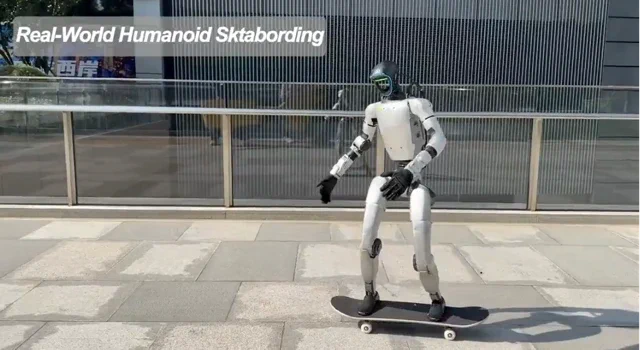
In a development that’s bound to make every teenager who ever skinned their knees on the pavement feel slightly inadequate, researchers have officially taught a humanoid robot how to skateboard. A new paper published on arXiv on 3 February 2026 details a system called HUSKY (Humanoid Skateboarding System), a physics-savvy AI framework that allows a bipedal robot to master the dynamically unstable and mechanically finicky nightmare that is riding a four-wheeled plank.
The “test pilot” for these experiments is the Unitree G1, a humanoid robot standing about 1.3 metres tall and weighing in at roughly 35kg. While already a dab hand at dancing and basic manipulation, the G1—which carries a starting price tag of around £12,500 ($16,000)—can now add “aspiring skate park regular” to its CV. The HUSKY system integrates whole-body control with a deep understanding of skateboard dynamics—modelling the complex relationship between board tilt and truck steering—to enable stable transitions between pushing off the ground and steering by leaning. To ensure the robot doesn’t look like a stiff piece of machinery, the system leverages Adversarial Motion Priors (AMP), a technique that encourages the robot to learn a natural style of movement rather than being explicitly programmed for every single twitch.
Why does this matter?
Teaching a robot to skateboard isn’t just about preparing for a future Robot Olympics. This research pushes the boundaries of whole-body control for humanoids in unpredictable, real-world scenarios. Mastering an underactuated platform like a skateboard demonstrates a sophisticated ability to manage balance, momentum, and human-object interaction simultaneously.
The principles behind HUSKY could eventually be applied to robots using other wheeled tools or navigating cluttered, dynamic human environments without constantly tripping over their own feet. It is a crucial step toward creating robots that move with the agility and adaptability of a human, rather than the rigid, stop-start precision of a factory arm.