Researchers from HKUST, IDEA Research, and Shanghai AI Laboratory have pulled a bit of a masterstroke with the introduction of HumanX. This full-stack framework teaches humanoid robots complex, real-world skills simply by having them watch videos of people. We’re talking about robots learning to dribble a football, box, or shift heavy cargo without the soul-crushing chore of task-specific reward programming that has historically acted as a handbrake on robotic development.
The secret sauce is a clever two-part process that effectively translates human movement into robotic “muscle memory”. First, a data-generation pipeline dubbed XGen scrutinises standard monocular videos of humans, synthesising the motion into physically plausible interaction data and beefing it up for variety. Then, a unified imitation-learning framework called XMimic uses that data to train the robot’s policy, allowing it to learn and generalise skills on the fly. The entire pipeline was successfully put to the test with a zero-shot transfer to a physical Unitree G1 humanoid—a proper “sim-to-real” triumph.
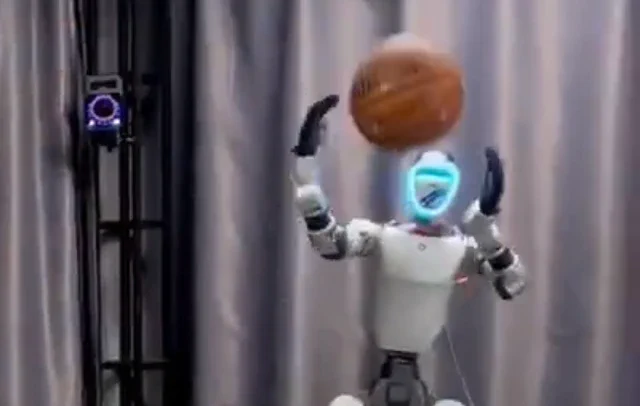
According to the research paper, this method achieves over eight times the generalisation success rate of previous attempts. The skills on display are impressively fluid, ranging from cheeky basketball pump-fakes to sustained human-robot passing sequences.
Why does this matter?
This is a massive leap towards the holy grail of truly general-purpose humanoids. For years, the biggest bottleneck in robotics hasn’t been the metal and motors, but the software—specifically the painstaking, manual process of coding every individual skill. Frameworks like HumanX propose a radical shortcut: leveraging the planet’s largest and most diverse dataset of physical tasks—YouTube, TikTok, and every other video platform on the web—to teach robots.
By binning the need for reward engineering, it dramatically lowers the barrier to entry for developing new robotic capabilities. Instead of needing a small army of engineers to hard-code a “pick up box” function, developers might eventually just need to show the robot a video of a warehouse operative. It’s a paradigm shift that could finally help humanoid hardware live up to its science-fiction billing.