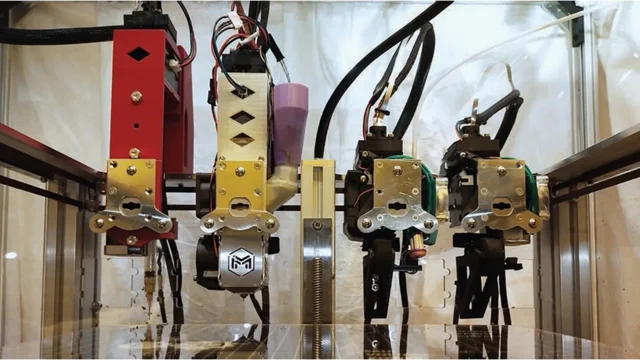
While the rest of us are still struggling to get our 3D printers to produce a half-decent plastic figurine without it turning into a bird’s nest, researchers at the Massachusetts Institute of Technology (MIT) have leapfrogged the hobbyist stage entirely. They aren’t just printing parts; they are printing fully functional electric motors.
In a single, continuous three-hour session, their custom-built machine can fabricate a complete linear motor from five different materials, with the total bill for materials coming in at less than 40p (around 50 cents). The only bit of manual labour required is a quick bit of magnetisation once the printer has finished its shift.
The breakthrough, detailed in the journal Virtual and Physical Prototyping, comes from a team at MIT’s Microsystems Technology Laboratories, including Jorge Cañada, Zoey Bigelow, and Luis Fernando Velásquez-García. They’ve essentially supercharged an existing 3D printer, retrofitting it with four distinct extrusion toolheads. These heads can juggle everything from rigid and flexible polymers to conductive silver ink and composite pellets packed with magnetic particles. This multi-modal approach allows the machine to lay down the motor’s dielectric housing, conductive coils, and magnetic components layer-by-layer without a single tea break.
Why does this matter?
This isn’t just about churning out cheap motors; it’s a fundamental shift in how we think about manufacturing. We are moving away from “printing parts” and towards “printing systems.” The ability to fabricate an entire electromechanical device on-site could be a massive win for sovereign capability, potentially ending our reliance on fragile global supply chains for critical components.
For the worlds of robotics, automation, and even bespoke medical kit, this opens the door to rapid prototyping and highly customised, integrated hardware that was previously impossible to build outside of a massive factory. According to the researchers, these printed motors didn’t just “work”—they performed as well as, if not better than, their conventionally manufactured counterparts. It’s a properly impressive bit of kit that suggests the future of the factory might just sit on your desktop.