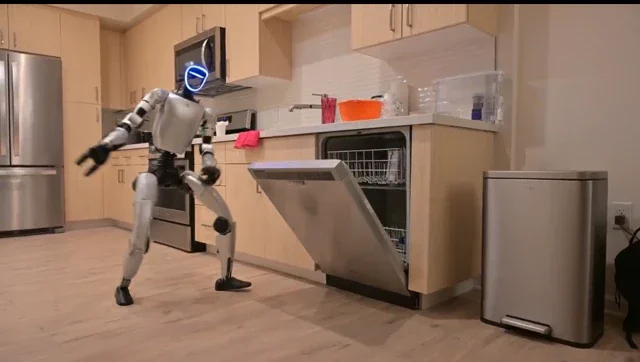
In a move that’s set to send a jolt of both adrenaline and anxiety through the robotics world, NVIDIA has just open-sourced SONIC. This isn’t just another piece of code; it’s a foundation model designed to finally nudge humanoid robots past the “expensive toy” phase and into the realm of actual utility. The mission, according to NVIDIA researcher Yuke Zhu, is to pivot the industry’s “singular focus” away from flashy, pre-programmed stunts and toward “putting generalist humanoids to do real work.”
Let that sink in: real work. Not just viral backflips, but the kind of graft that actually matters.
SONIC—an acronym for Supersizing mOtion tracking for Natural humanoId Control—is what’s known as a “Behavior Foundation Model” for real-time, whole-body motion. It has been fed a staggering diet of over 100 million frames of human motion capture data. That’s more than 700 hours of people running, jumping, and crawling, distilled into a digital brain. The result? Robots gain a foundational “feel” for natural movement without the usual, soul-crushing faff of task-specific reward engineering. The system is versatile, too, supporting everything from direct teleoperation to inference via Vision-Language-Action (VLA) models, allowing a single, unified policy to call the shots.
And it’s not just a laboratory curiosity. One beta tester reported getting the system up and running in a matter of hours, describing the performance as “superior.” In a field where fine-tuning a controller usually takes months of painstaking calibration, a setup time measured in hours is nothing short of a miracle.
Why does this matter?
For years, the humanoid robotics scene has been trapped in a bit of a demo loop. We’ve seen plenty of impressive but brittle displays of agility that fall apart the moment they’re asked to do something useful in the real world. By open-sourcing a high-calibre, generalist controller, NVIDIA is essentially commoditising the hardest part of the job.
They’re lowering the barrier to entry for startups and researchers, freeing them up to focus on high-level reasoning and complex tasks rather than reinventing the robotic wheel. It’s a calculated tactical play, clearly linked to NVIDIA’s broader Project GR00T (Generalist Robot 00 Technology) initiative to build a standardised software and AI ecosystem for the robots of tomorrow. The era of robots performing for clicks might finally be coming to a close, replaced by something far more mundane—and infinitely more valuable: robots that can actually get on with the washing up.