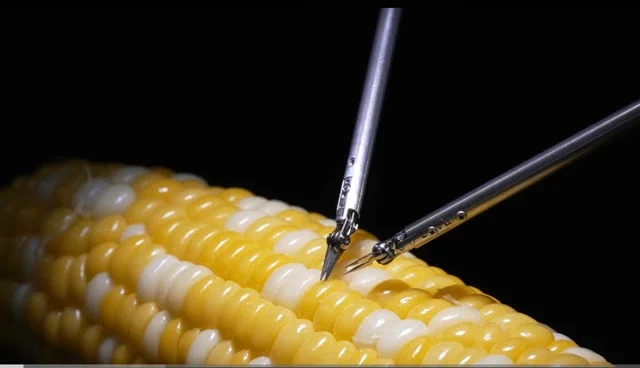
If you thought your hands were steady, Sony Group Corporation has a robot that might just bruise your ego. The tech giant recently pulled back the curtain on its new microsurgery assistance robot prototype at the ICRA 2024 conference, and its opening gambit was a masterclass in precision: suturing a single kernel of corn. It’s a feat of dexterity that makes threading a needle look like a clumsy game of Operation. [1, 5] But the viral demo actually buried the lede. In a February 2024 trial at Aichi Medical University, the robot enabled medical staff who were not specialised in microsurgery to successfully connect animal blood vessels with a diameter of just 0.6 mm. [7, 8]
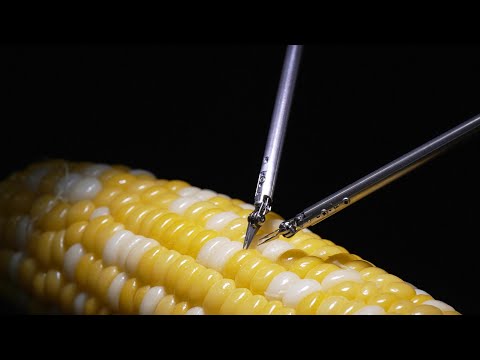
To be clear, this isn’t an autonomous surgeon coming for anyone’s job; it’s a highly sophisticated teleoperation tool designed to augment human talent. [3, 14] The system translates a surgeon’s hand movements from sensitive, pen-like controllers to the robot’s miniaturised instruments, filtering out natural tremors and offering a level of precision that is, quite literally, superhuman. [16, 21] The operator monitors the site through a stereoscopic 4K OLED microdisplay—a move that leans heavily into Sony’s world-class imaging pedigree. [1, 4, 13] One of the most clever innovations here is the robot’s ability to automatically swap its own tiny surgical tools, a feature intended to strip away the interruptions and faff that often plague conventional robotic-assisted procedures. [6, 12]
Why does this matter?
Super-microsurgery, which involves operating on nerves and vessels often less than a millimetre wide, is a “dark art” currently limited to a tiny elite of global specialists. [8, 14] Sony’s prototype isn’t about replacing those experts, but about democratising their skills. [3] By creating a system that allows non-specialists to perform incredibly delicate tasks, Sony is tackling a mounting crisis: a global shortage of highly trained surgeons, made worse by an ageing workforce. [4, 6] This technology could make complex, life-saving procedures more accessible and consistent, proving that the steadiest hand in the operating theatre might soon be a robotic one.