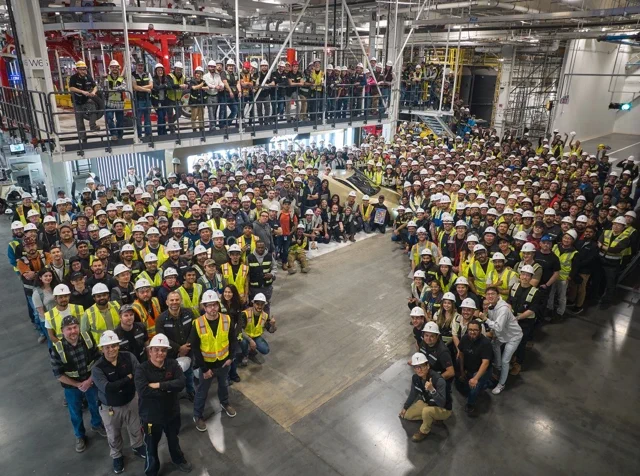
Tesla, Inc. has officially rolled its first production Cybercab off the assembly line at its Gigafactory in Austin, Texas. The company announced the milestone in a 17 February 2026 post on X, sharing a glimpse of the futuristic, two-seater vehicle mobbed by the factory workers who brought it to life. This marks the first tangible unit of a car that has, until now, existed almost entirely within the ambitious timelines and PowerPoint decks of CEO Elon Musk.
The Cybercab—or Robotaxi, depending on who you ask—is Tesla’s purpose-built autonomous vehicle. It famously ditches the steering wheel and pedals entirely, a bold (and legally audacious) commitment to a future where the car does all the heavy lifting. While Musk has consistently pointed towards an April 2026 production start, he has also cautioned that the initial ramp-up will be “agonisingly slow” as the company grapples with an entirely new manufacturing philosophy and vehicle architecture.
This isn’t just a new model; it’s the linchpin of Tesla’s plan to launch a massive autonomous ride-hailing network designed to pull the rug out from under services like Uber and Lyft. The company is already running a small-scale “Robotaxi” pilot in Austin using supervised Model Ys, but the Cybercab is the real deal: a vehicle designed from the ground up for high-volume, low-cost production. Musk has set a “moonshot” goal of producing one vehicle every 10 seconds, targeting an eventual annual capacity of 2 million units.
miért is fontos ez?
The arrival of a production-intent Cybercab is a major shot across the bows in the autonomous vehicle race. While rivals like Waymo currently operate larger fleets—Waymo has roughly 2,500 vehicles to Tesla’s few hundred—they are primarily retrofitting existing car models with expensive sensors. Tesla’s strategy is a different beast entirely: mass-produce a cheaper, dedicated vehicle to achieve a level of scale that others simply can’t match.
However, the road ahead is far from a smooth Sunday drive. Tesla has yet to achieve true, unsupervised Level 5 autonomy, and its Full Self-Driving (FSD) software remains a “supervised” system for now. Furthermore, UK and US regulators are still mulling over the safety implications of vehicles operating without traditional driver controls on public roads. This first Cybercab is a significant manufacturing achievement, but it’s also the starting pistol for a much longer, more complex race against technology, regulation, and public trust.