Researchers from the University of Cambridge and Japan’s National Institute of Advanced Industrial Science and Technology (AIST) have just unveiled a system that essentially teaches robot swarms to fly like Red Bull Air Race pilots—minus the inevitable mid-air wreckage. The study, published in the March 19 edition of npj Robotics, introduces a framework for “kinodynamically aggressive manoeuvres” among multiple agents. In plain English: they’ve cracked the code for getting clusters of robots to move at breakneck speeds through tight gaps without ending up in a very expensive pile of scrap metal.
The paper, titled “Concrete Multi-Agent Path Planning Enabling Kinodynamically Aggressive Maneuvers,” was announced by lead author Keisuke Okumura, a researcher at AIST and a visiting scholar at Cambridge. The fundamental headache in multi-agent pathfinding (MAPF) is that as you add more robots to the mix, the mathematical complexity of calculating collision-free routes doesn’t just grow—it explodes. This new “concrete planning” method cleverly mashes together continuous, real-world physics with a more nimble discrete search, allowing the system to calculate optimal flight paths for dozens of robots simultaneously in the blink of an eye.
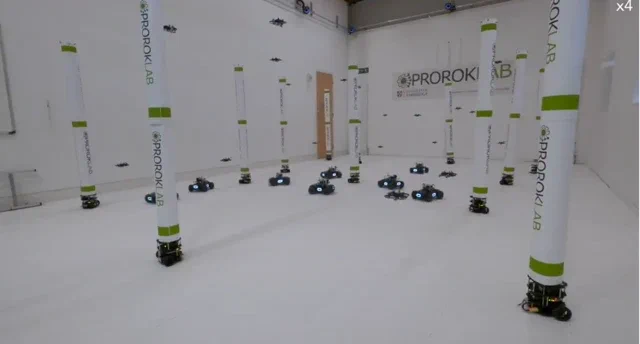
The term “kinodynamic” is the secret sauce here. It means the planning doesn’t just look at where the robots are (kinematics), but also accounts for the raw forces and momentum at play (dynamics). It’s the difference between drawing lines on a map and trying to choreograph a fleet of speeding F1 cars that can’t exactly stop on a sixpence. The researchers put their theory to the test by unleashing 40 robots—including 20 quadrotors and 8 ground bots—in a cramped lab space, where they successfully pulled off complex, high-speed manoeuvres without a single clipped wing.
Why does this matter?
This research isn’t just a cool lab trick; it tackles the primary bottleneck currently stifling the potential of swarm robotics. While the drone light shows and automated warehouses we see today are impressive, they usually play it very safe, relying on wide margins and sedate, “after you, Claude” movements to avoid disaster. By creating a system that can plan “aggressive” and tightly-knit movements in seconds, this work sets the stage for a far more dynamic future.
Imagine warehouse robots that don’t just trundle along pre-set tracks, but actively weave around one another at high speed to shave seconds off delivery times. Or picture search-and-rescue drone swarms that can acrobatically navigate the jagged ruins of a collapsed building. This Cambridge-led breakthrough provides the algorithmic backbone to turn those sci-fi dreams into a practical reality, shifting multi-robot coordination from being cautiously polite to being brilliantly, brutally efficient.