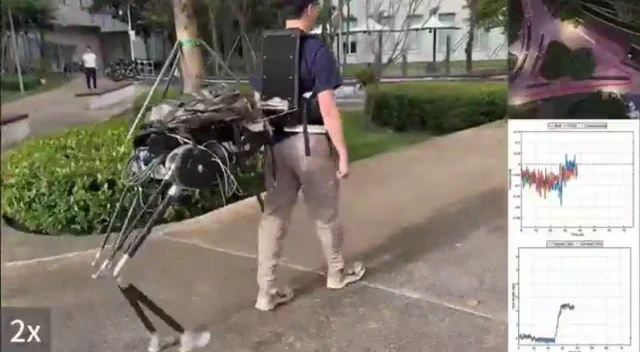
Just when you thought wearable robotics was all about squeezing into a rigid metal cage, researchers at the Southern University of Science and Technology (SUSTech) have decided to give us a robotic rear end instead. No, it’s not a joke; it’s a remarkably clever new take on helping humans shift heavy loads without breaking their backs.
Led by Professor Chenglong Fu, the team has cooked up a wearable “Centaur” system—essentially a pair of independent robotic legs that hitch a ride on your back. The aim isn’t to turn you into a superhero, but to offload the hard graft more intelligently. By shouldering the vertical weight, the device cuts a user’s metabolic cost by a whopping 35% and slashes foot pressure by 52% when lugging a 20kg pack.
Unlike standard exoskeletons that run alongside your legs and can feel a bit cumbersome, this quadrupedal setup works “in series” with the wearer. A specialised elastic coupling links the robotic limbs to the pilot, staying stiff for snappy movements but softening to soak up shocks. This “dynamics decoupling” means the human handles the navigation and balance, while the robot provides the steady, load-bearing grunt. It’s surprisingly nimble, too, capable of nipping through figure-eight turns and tackling stairs or uneven ground with ease.
Why does this matter?
The research, recently featured in the International Journal of Robotics Research, suggests that the best way to boost our carrying capacity isn’t to encase our limbs in metal, but to sprout new ones entirely. By splitting the labour—human for the brains, robot for the brawn—the centaur concept could revolutionise logistics, disaster relief, and any job where heavy lifting is part of the daily grind. It’s less Iron Man and more of a very handy mythological beast, ready to do the heavy lifting so you don’t have to.