Swedish freight disruptor Einride is quietly persuading some of the world’s biggest players to pension off the traditional lorry driver—or, more accurately, the cab they sit in. The company’s fleet of electric and autonomous HGVs is already on the clock for corporate titans like PepsiCo, Mars, and GE Appliances, proving that the era of robotic logistics isn’t just a slide deck fantasy; it’s actually making deliveries.
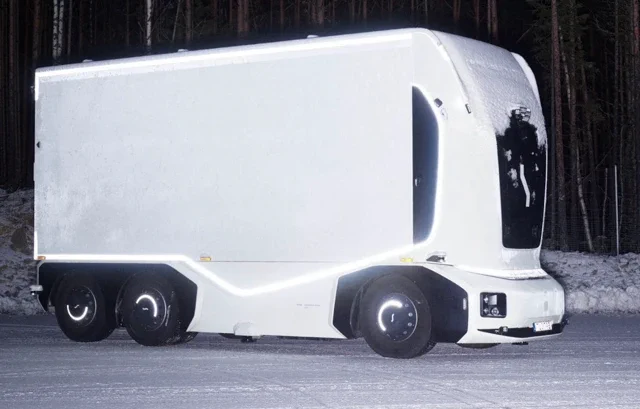
Einride’s strategy is a clever cocktail of future-tech. Its most recognisable vehicle, the cab-less Einride Pod, is a masterclass in “form following function”. By removing the need to accommodate a human driver, the vehicle’s entire volume is dedicated to cargo, resulting in a sleek, almost alien aesthetic. These SAE Level 4 autonomous trucks are already navigating public roads across the US and Europe, kept under the watchful eye of remote human operators. In a landmark moment for the industry, an Einride vehicle completed the world’s first fully autonomous, cross-border delivery between Sweden and Norway in late 2025. For routes that require a bit more versatility, the firm also deploys fleets of more conventional-looking (though entirely electric) heavy-duty trucks, all orchestrated by “Saga”, its AI-driven logistics platform.
These partnerships have moved well beyond the “token pilot” phase. With Mars, Einride is rolling out a fleet of 300 electric trucks across Europe by 2030, with the aim of slicing 20,000 metric tonnes of CO2e from the atmosphere every year. Meanwhile, its US operations with PepsiCo’s Frito-Lay are expected to clock up nearly 200,000 miles annually, saving 143 metric tonnes of CO2e in the process. The company claims its electric transport ecosystem can slash carbon emissions by up to 95% compared to diesel, all while remaining competitive on the balance sheet.
Why does this matter?
While the tech press is currently obsessed with humanoid robots and generative AI, Einride is tackling a far grittier, more essential problem: road freight, which accounts for a massive 7% of global CO2 emissions. By stitching together electric drivetrains, autonomous tech, and an AI management layer, Einride is offering a “freight-as-a-service” model that actually holds water for risk-averse, blue-chip companies.
With a fresh $113 million (£89 million) in funding secured in February 2026 ahead of a planned NYSE debut, Einride has the war chest needed for global expansion. Its success highlights a viable, scalable route to decarbonising the supply chain—not in some distant “Net Zero 2050” dreamscape, but right now, on the motorways of Europe and the US. The question is no longer if autonomous electric freight will take the lead, but how quickly the rest of the industry can pivot before they’re left in the diesel dust.