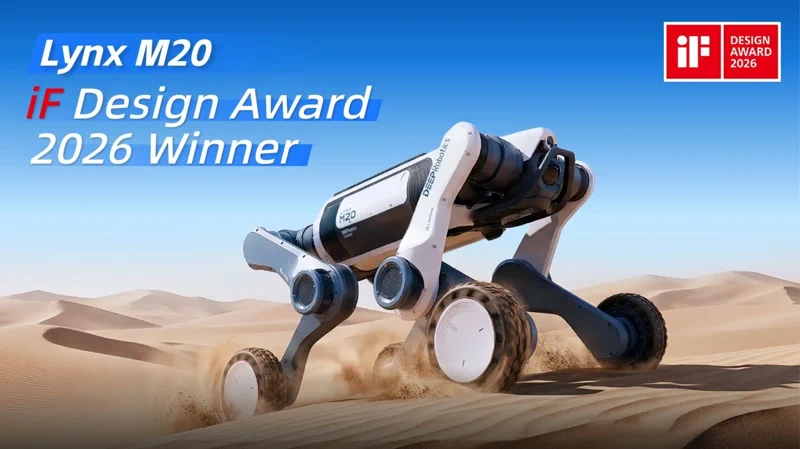
DEEP Robotics has just been given a well-deserved pat on the back by the design elite, bagging a 2026 German iF Design Award for its Lynx M20 wheeled-legged robot. The iF Award, a prestigious gong that’s been running since 1953, clearly found the M20’s blend of industrial chic and rugged practicality more impressive than the tens of thousands of other hopefuls. It’s another trophy for the cabinet for a robot that already sports a CES 2026 Innovation Award, proving that even hardware built for the grittiest environments can appreciate a bit of red-carpet recognition.
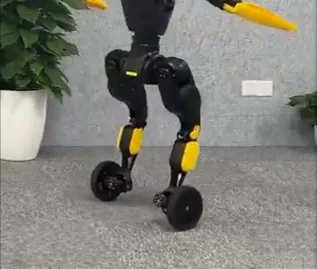
The core philosophy here is “form follows function,” which is essentially a polite way of saying it’s built for the grind, not the gallery. The Lynx M20 features a clever symmetrical design for squeezing through tight spots and a “front elbow, rear knee” leg configuration that keeps it stable and compact. Its real party trick, however, is the hybrid wheel-leg system. This allows it to cruise at a brisk 5 m/s on flat ground before switching to its legs to tackle the sort of terrain that would leave a standard robot spinning its wheels. The whole kit—from the limbs to the central control unit—is modular and designed for quick disassembly. After all, nobody wants to be faffing around with a toolkit in the middle of a muddy field.

This robot is purpose-built to go where humans would rather not. It boasts a solid IP66 rating, meaning it’ll laugh in the face of dust, rain, and snow. With an operating temperature range of -20°C to 55°C and the muscle to carry a 15 kg payload, it’s designed to haul gear in environments that are frankly miserable for people. Thanks to hot-swappable batteries, it can work longer shifts than a junior doctor, providing up to 2.5 hours of loaded runtime for continuous operation without needing a lengthy power nap.

While some robots are still struggling to master the art of opening a door, the Lynx M20 is already gainfully employed. It’s been deployed in power substations, joined security patrols for public safety bureaus, and even landed a gig as a camera operator for the Chinese Super League finals—giving footy fans the world’s first “robot dog’s eye view” of a professional match. From high-altitude supply runs in Hoh Xil to hauling crops in Chongqing, these real-world shifts prove it’s far more than just a pretty piece of hardware.

Why does this matter?
This award isn’t just about a sleek silhouette. It’s a validation that the most effective industrial robots are those where every design choice serves a practical, often grueling, purpose. The success of the Lynx M20 highlights a major shift: the maturation of embodied AI from lab-bound experiment to a reliable tool for sectors like energy and public safety. The hybrid wheel-leg design is the industry’s answer to the need for a single platform that can zip across a paved warehouse and then immediately navigate the rough, uneven ground outside the factory gates. For DEEP Robotics, it solidifies their status as a heavyweight in the field, proving that their focus on solving real-world headaches is getting noticed globally. The age of the practical, versatile quadruped hasn’t just arrived; it’s already clocked in for its shift at a power station near you.