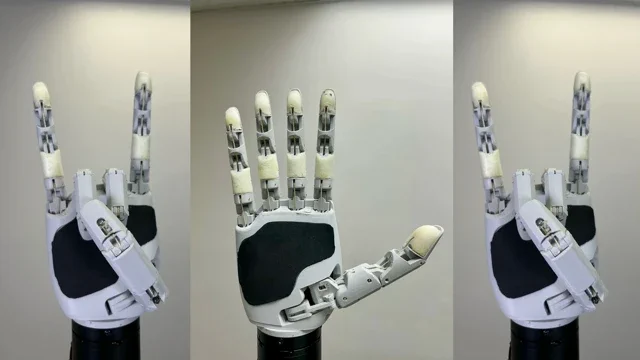
In a world where a single dexterous robotic hand can set you back more than a decent semi-detached house—think north of £120,000—a Silicon Valley startup is pitching a radically more accessible alternative. TetherIA, a fledgling firm founded in early 2025 by veterans from the Tesla Optimus and Waymo foundational model teams, has pulled the curtains back on the Aero Hand Open: a fully open-source robotic hand that can be assembled from a kit for a mere £250 ($314).
The Aero Hand Open is a five-fingered, tendon-driven manipulator designed specifically to smash the high entry barriers of robotics research. The entire chassis is 3D-printable from nylon, and it relies on off-the-shelf electronic components to keep costs firmly on the ground. Its architecture features 7 active degrees of freedom across 16 joints, all packed into a svelte 389g package. The tendon-driven design, where cables route forces from a handful of motors to multiple joints, allows for the kind of fluid, natural, and compliant motion that mimics the human touch.

On the software front, TetherIA is ensuring the hand is “AI-ready” out of the box. It is fully compatible with ROS2 systems, ships with its own Python SDK, and is already a native in the MuJoCo physics simulator, with NVIDIA Isaac Sim support reportedly in the pipeline. This allows researchers to stress-test control policies and benchmark algorithms in a virtual sandbox before deploying them on the physical hardware.
Why does this matter?
For far too long, the eye-watering cost of hardware has acted as a bottleneck for progress in dexterous manipulation. While the Aero Hand Open isn’t looking to trade blows with a six-figure industrial powerhouse, its bargain-basement price point and open-source DNA could truly democratise the field. By making a capable, anthropomorphic hand accessible to cash-strapped university labs, schools, and even basement tinkerers, TetherIA is providing the tools for a much broader community to tackle one of robotics’ “grand challenges.” Coming from a team with this kind of pedigree, this isn’t just a hobbyist project; it’s a calculated strategic move to accelerate innovation from the ground up.