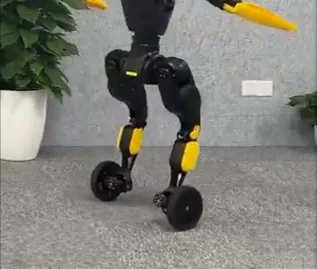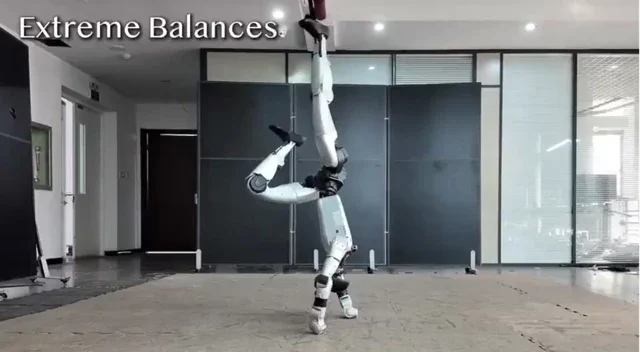
In a refreshing departure from the usual stiff, over-choreographed routines, researchers have unveiled OmniXtreme—a general AI policy that allows a humanoid robot to nail consecutive backflips, balance in precarious positions, and even bust out some breakdance moves. Demonstrated on a Unitree Robotics G1, this isn’t just another “one-trick pony” like the admittedly flashy but hyper-specialised WuBOT seen at the 2026 Spring Festival Gala. This is about genuine, versatile athleticism.
The year-long project, a joint effort with Unitree, clearly wasn’t for the faint-hearted. The research team admitted to “burning through dozens of G1 robots” to finally crack the code on general dynamic movement. Given the G1’s entry-level price tag of around £10,500 ($13,500), that’s a significant amount of hardware to sacrifice at the altar of reinforcement learning. The goal was to smash through the barrier that separates robots trained to follow a single specific motion from those that can actually handle the messy, chaotic physics of high-stakes, real-world manoeuvres.
The secret sauce is a two-stage training recipe. First, a flow-based generative control policy is pre-trained, giving the robot a foundational “feel” for movement. Then, it undergoes post-training using “actuation-aware residual RL”—a critical step that fine-tunes the model to account for the complex dynamics and physical limitations of the actual hardware. The researchers reckon this second stage was the “eureka moment” for successfully bridging the notoriously difficult “sim-to-real” gap. In a move that’ll please the open-source community, the model checkpoints have been released on GitHub.
Why does this matter?
Developing a single, unified policy for such a broad range of high-impact movements is a proper milestone. It signals a shift from building robotic “specialists” that can only perform one spectacular trick to creating true “generalists” with a wide physical vocabulary. By successfully navigating the “sim-to-real” gap for extreme dynamics, OmniXtreme provides a viable framework for building more robust, adaptable, and physically capable humanoid robots. Now that the models are out in the wild, the race to create the multi-talented robot gymnasts and dancers of the future is officially on.