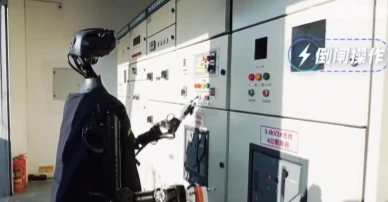
The State Grid Corporation of China is splashing out a cool $1 billion (£800 million / RMB 6.8 billion) on a new workforce that doesn’t require tea breaks, pension schemes, or safety harnesses: an 8,500-strong battalion of embodied AI robots. This isn’t merely a case of droids sweeping the warehouse floor; it’s a massive, state-backed offensive to automate the country’s gargantuan power grid, pivoting from human-led maintenance to almost entirely autonomous operations. The procurement roadmap for 2026 alone signals a tectonic industrial shift, putting cold steel where flesh and blood used to tread.
The shopping list features a menagerie of robotic platforms tailored for over 600 specialised tasks. The headliners are 500 humanoid robots earmarked for the most perilous jobs on the circuit, such as live-line maintenance on ultra-high-voltage pylons. These bipedal workers account for a staggering $370 million (RMB 2.5 billion) slice of the budget. They’ll be supported by 5,000 quadruped “robodogs” for inspections and 3,000 dual-armed wheeled bots, creating a seamless, collaborative maintenance ecosystem. A “who’s who” of Chinese robotics heavyweights—including Unitree, AGIBOT, DeepRobotics, UBTECH, and Fourier Intelligence—are all queued up as primary suppliers.
Why does this matter?
State Grid isn’t buying these for the sci-fi aesthetics. The cold, hard economics are remarkably efficient. The company estimates that each robot will save between $70,000 and $110,000 (£55,000–£85,000) in annual labour costs, promising a brisk two-to-three-year ROI. More crucially, the initiative aims to slash human exposure to high-risk environments by over 90% and drop safety incidents by 80%.
The rollout is nothing short of aggressive: the strategy demands that embodied AI covers 30% of key grid zones by 2026, 80% of high-risk scenarios by 2027, and achieves fully autonomous operations by 2030. This isn’t a tentative pilot programme; it’s a full-scale industrial revolution. By deploying robots at this magnitude, State Grid is transforming the world’s largest utility into a massive, real-world laboratory for embodied AI. This will inevitably turbocharge innovation across the sector. What starts with the power grid today will almost certainly be replicated across China’s other vast infrastructure networks tomorrow.