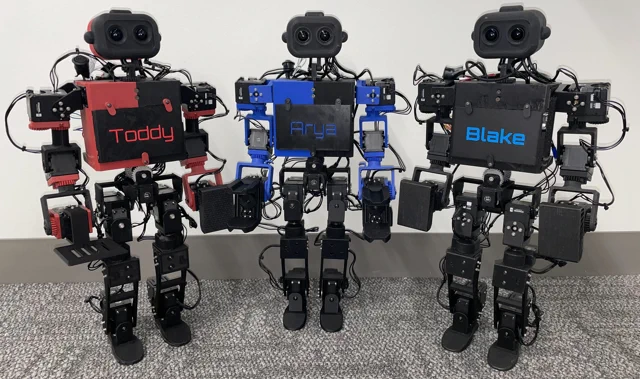
Forget the eye-watering price tags usually slapped on cutting-edge humanoid robots – the kind that make a luxury motor look like a bargain basement buy. A groundbreaking new project is taking a refreshingly down-to-earth, and frankly, brilliant, approach. Say hello to ToddlerBot, a low-cost, open-source humanoid platform designed to bring advanced AI and robotics research to the masses for a mere bill of materials totalling under $6,000. The brainchild of Stanford University Ph.D. student Haochen Shi, this initiative aims to throw open the doors of a field long hogged by well-heeled corporate behemoths and ivory tower boffins.
At its heart, ToddlerBot is all about providing a scalable, reproducible platform for data-driven research, particularly in that tricky dance of “loco-manipulation” – the complex choreography of moving about whilst deftly handling objects. Standing at a compact 0.56 metres and tipping the scales at 3.4 kg, this little marvel is designed to be a doddle to operate safely in real-world settings. Its 30 degrees of freedom, an entirely 3D-printable body, and its reliance on readily available, off-the-shelf components make it utterly accessible for even modestly kitted-out labs and keen-as-mustard enthusiasts alike. And for those eager to dive in, the complete open-source plans, from the 3D models on MakerWorld to the Python-based control code, are all freely available on GitHub. Hyperlink: ToddlerBot on GitHub
The latest V2.0 release, now live on MakerWorld, brings even more bells and whistles to the robot’s already impressive repertoire, which includes walking, crawling, and even busting out a few push-ups. Crucially, the platform has been engineered for machine learning compatibility from the ground up, boasting a high-fidelity digital twin that allows for seamless sim-to-real policy transfer. This means researchers can train their AI models in a virtual playground and then deploy them on the physical robot with precious little faff.
Why is this important?
The six-figure cost of most research-grade humanoids creates a monumental hurdle, effectively putting a chokehold on innovation. By slashing the price to around $6,000—with a staggering 90% of that going on motors and computers—ToddlerBot throws a lifeline to smaller universities, nimble startups, and even the most ambitious bedroom tinkerers, enabling them to genuinely contribute to the field. This isn’t just about knocking out a cheaper robot; it’s about fostering a larger, more diverse community of bright minds. An accessible platform like ToddlerBot could significantly accelerate progress in embodied AI, reinforcement learning, and physical human-robot interaction, proving once and for all that the future of robotics doesn’t have to come with a frankly extortionate price tag.