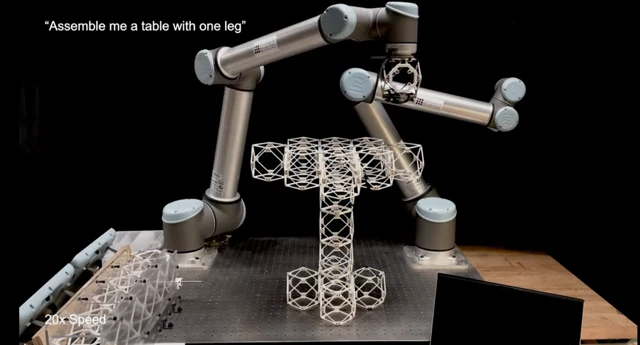
Researchers at the Massachusetts Institute of Technology (MIT) have unveiled a “Speech-to-Reality” system, an AI-driven workflow that allows a robotic arm to conjure up furniture based on nothing more than a simple voice command. You can officially bin your Allen keys and toss those indecipherable assembly diagrams; this system can piece together a stool or a shelf from modular parts in under five minutes after hearing a prompt as straightforward as, “I want a simple stool.”
The project, which emerged from Professor Neil Gershenfeld’s legendary “How to Make Almost Anything” course, merges several fast-moving frontiers of tech into a single, elegant pipeline. “We’re bridging the gap between natural language processing, 3D generative AI, and robotic assembly,” says Alexander Htet Kyaw, an MIT graduate student spearheading the project at the MIT Center for Bits and Atoms (CBA). The workflow is clever: a large language model (LLM) decodes the user’s request, a 3D generative AI drafts the digital blueprint, and a suite of algorithms then calculates the most efficient “path to build” for the robot to follow.
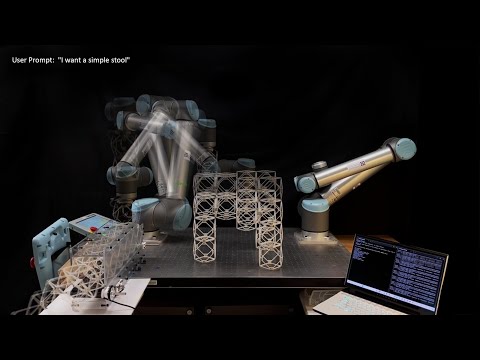
To date, the team has successfully “talked” the robot into building stools, shelves, chairs, a coffee table, and—for the more whimsical—a decorative dog statue. Crucially, the components are designed for a circular economy; they can be snapped apart and reused, offering a far more sustainable alternative to the “fast furniture” culture. While the current prototypes rely on magnetic connections, the researchers are already looking to integrate more robust mechanical joints to ensure the furniture can handle the weight of actual human use.
Why does this matter?
This system represents a massive stride toward the democratisation of manufacturing. By stripping away the need for a PhD in 3D modelling or complex robotics programming, MIT is handing the keys to bespoke creation to the average person. It’s far more than a laboratory party trick; it is a profound proof-of-concept for a future where the physical world is as malleable as code. Instead of losing a Saturday afternoon to flat-pack hell, you could simply describe your vision and watch it materialise. The prospect of reconfiguring your entire living space with a quick word—perhaps turning a guest bed back into a sofa once the in-laws have left—suggests a future of truly fluid, adaptable homes.