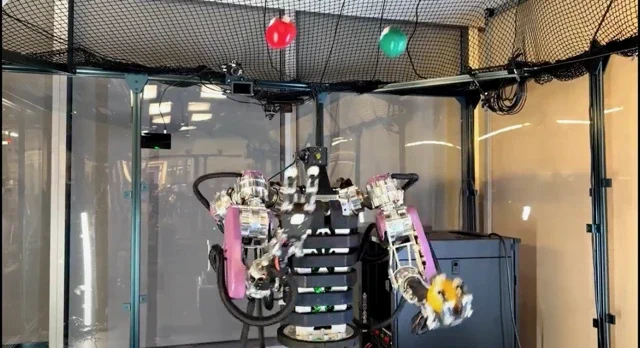
The Robotics and AI Institute (RAI), the research powerhouse spearheaded by Boston Dynamics founder Marc Raibert, has just pulled back the curtain on AthenaZero. This bimanual bot doesn’t move with the jerky, mechanical stutter we’ve come to expect from factory floor veterans; instead, it exhibits a fluidity that’s much closer to human grace. In a deep-dive blog post published on 7 April, RAI detailed the new prototype, which has been engineered specifically for “dynamic manipulation”—a holy grail in robotics that requires two hands to work in perfect, high-speed harmony.
While most industrial robots are notoriously stiff and clumsy due to high gear ratios, AthenaZero is a different beast entirely. Standing at 5ft 3in, the robot features twin 7-degree-of-freedom (DoF) arms that prioritise low inertia and rapid acceleration. The “secret sauce” lies in its quasi-direct drive actuators, which make the robot “force transparent.” In layman’s terms, this means AthenaZero can instantly pivot from applying the brute force needed for heavy lifting to a delicate, compliant touch for fragile tasks—a feat that usually leaves traditional robots either stalled or breaking things.
The ultimate goal here isn’t just to bolt two arms onto a torso; it’s to build a platform capable of mastering complex, coordinated movements. Bimanual manipulation is the key to unlocking automation for tasks that are currently impossible for one-armed bots—think assembling intricate electronics, handling flexible fabrics, or anything that requires more than just “pick up and drop.”
Why this is a game-changer
For decades, automation has been synonymous with powerful but dim-witted arms performing the same repetitive motions ad nauseam. The Robotics and AI Institute is attacking this limitation from both ends: crafting hardware like AthenaZero that is physically capable of nuanced interaction, and developing the AI and reinforcement learning models to drive it. By building a system from the ground up for learning-based control, RAI is taking a massive leap towards a “general-purpose manipulator.” This is the kind of foundational research that could finally allow robots to step out of their safety cages and into the unpredictable, messy reality of the real world.