In a feat of bio-engineering that feels more like a discarded Black Mirror script than a laboratory report, researchers in South Korea have found a way to wirelessly toggle specific genes in living mice. The “remote control” in question? The same 60 Hz electromagnetic frequency you’d find humming from a standard wall socket.
The groundbreaking study, recently published in the journal Cell, introduces a non-invasive “magnetogenetic” switch that could fundamentally rewrite how we study—and eventually treat—human disease.
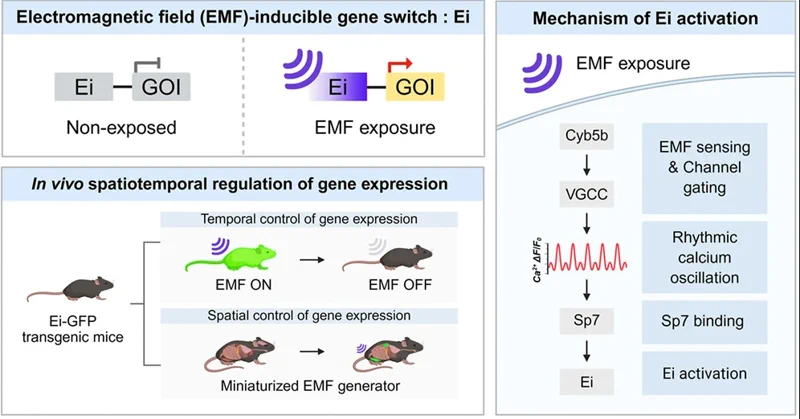
The team, hailing from the Korea Advanced Institute of Science and Technology (KAIST), demonstrated the system’s sheer potential through some truly remarkable biological wizardry. Using their electromagnetic field setup, they successfully activated genes responsible for epigenetic reprogramming in elderly mice, effectively turning back the clock on ageing markers across various tissues. In a separate experiment, they managed to conditionally trigger mutant amyloid genes specifically in the brains of older mice. This allowed them to create a much “cleaner” model for studying Alzheimer’s, stripping away the usual confounding variables of natural ageing. Most impressively, this was all achieved without a single drug or invasive implant—just a precisely calibrated magnetic field.
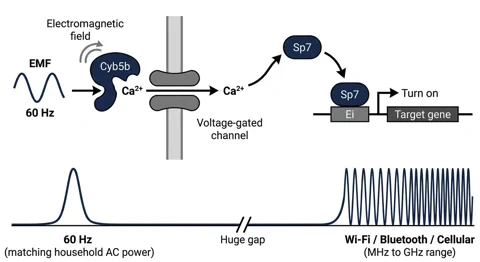
The science behind this biological remote control is as elegant as it is specific. The low-frequency electromagnetic field is “sensed” by a protein known as Cytochrome b5 type B (CYB5B). This interaction triggers voltage-gated calcium channels to open, but rather than just dumping calcium into the cell willy-nilly, it produces a series of rhythmic pulses. This specific oscillation is the “code” that activates a transcription factor called SP7, which then binds to a target DNA sequence to flip the desired gene to the “on” position. The researchers noted that simply flooding the cell with calcium using other methods did absolutely nothing; the secret sauce, it turns out, is the rhythm of the signal.
Why does this matter?
This research represents a massive stride forward for remote biological control. While techniques like optogenetics (using light to control cells) have been around for a while, they usually require faffing about with invasive fibre optic implants to get the light deep into the body. Magnetogenetics, by contrast, uses low-frequency fields that can pass through tissue entirely harmlessly and non-invasively. This paves the way for therapies that could be toggled on and off as required using an external device.
The potential applications are, quite frankly, staggering—ranging from kickstarting regenerative processes to targeting cancer cells with pinpoint accuracy. While we are still a long way from seeing these “gene switches” in a clinical setting for humans, this work provides a powerful new tool for the lab and a tantalising glimpse into a future where managing our own biology might be as simple as flicking a switch. You can dive into the full paper in Cell: A wirelessly controlled magnetogenetic gene switch for non-invasive programming of longevity and disease.