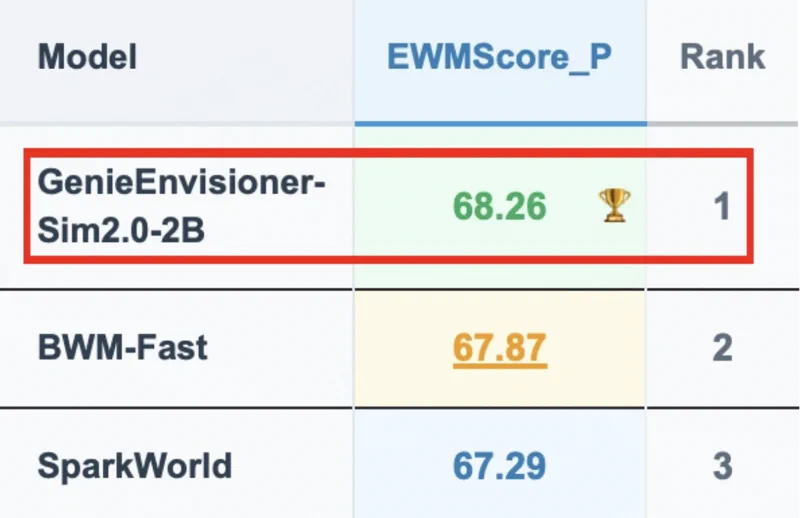
In a classic case of punching well above its weight, a nimble 2-billion-parameter world model from AGIBOT has just muscled its way to the top of the WorldArena benchmark. The newcomer, christened Genie Envisioner-Sim 2.0 (GE-Sim 2.0), is currently sitting pretty at the #1 spot, looking down on the bloated generative video engines that usually hog the limelight. It turns out that while making a cinematic video is all well and good, teaching a robot to fold a tea towel without a meltdown is a different kettle of fish entirely.
This isn’t just another flashy video generator for the “vibes.” GE-Sim 2.0 is a closed-loop physical simulator designed as a high-octane boot camp for actual hardware. It boasts “High-Consistency Multi-View Generation,” which is a fancy way of saying the robot’s head camera and wrist cameras actually agree on what they’re seeing—even if an object is tucked away in a blind spot or bouncing off a mirror. It’s this level of obsessive precision that separates a proper simulation from a digital hallucination.
To get this over the line, AGIBOT tackled three major simulation headaches. First up, a “Proprioceptive State Expert” decodes joint angles directly from video feeds, preventing the robot from spiralling into mechanical anarchy. Then there’s the “VLM-Based World Judge”—essentially an automated referee that scores simulation runs so human engineers can actually go home for dinner. Finally, using a clever distribution-matching distillation framework, they’ve managed to whittle down inference times, churning out a complex 25-frame multi-view sequence in a snappy 2.3 seconds.
Why does this matter?
Because the results are the real McCoy. Physical robots trained on GE-Sim 2.0’s refined synthetic data saw a whopping 15% boost in real-world success rates for tricky, contact-heavy tasks. This is a massive leap towards solving the “data drought” in embodied AI. While the rest of the industry is obsessed with visual polish, AGIBOT is building the practical, physical foundations that make robots genuinely useful. The days of robots just looking the part are gone; we’re entering the era where they actually do the job.
The project is open-source, so you can have a poke around the code yourself. Check out the code on GitHub or read the full paper on arXiv.