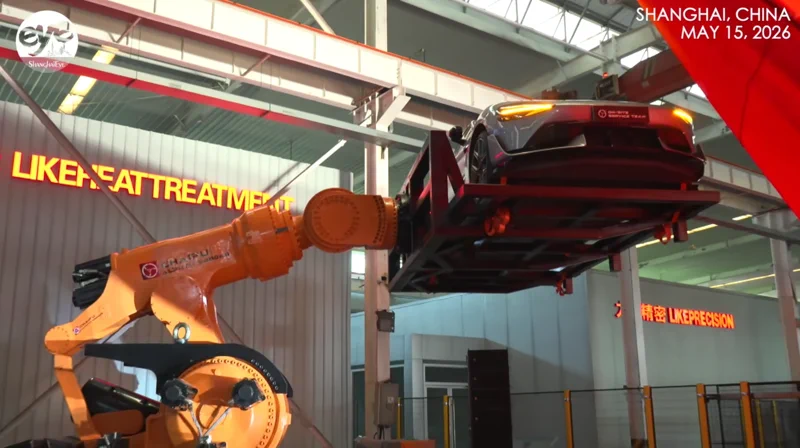
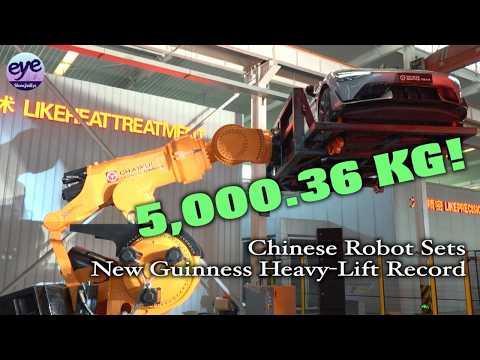
In the world of industrial robotics, there’s a new undisputed king of the heavyweights, and it isn’t playing nice. Shanghai Chaifu Robot Co., Ltd. has officially bagged the Guinness World Record for the “strongest industrial robot” with its new CR5000-3700, a behemoth of a machine that hoisted a staggering 5,000.36 kg (that’s over five tonnes). This achievement doesn’t just nudge the goalposts; it completely moves them, more than doubling the 2,300 kg benchmark set by Japan’s Fanuc Corporation back in 2016.
Let’s put this colossus into perspective. The CR5000-3700 stands 3.66 metres tall (about 12 feet) and tips the scales at a massive 19 tonnes. Despite its sheer bulk, it can manoeuvre five-tonne loads with a repeat positioning accuracy of 0.3 mm, making it a terrifyingly precise instrument for the most punishing industrial tasks. The previous titleholder, Fanuc’s M-2000iA/2300, held the crown for eight years and is a formidable 11-tonne machine in its own right. But Chaifu Robot hasn’t just joined the heavyweight division; it has redefined the weight class entirely.
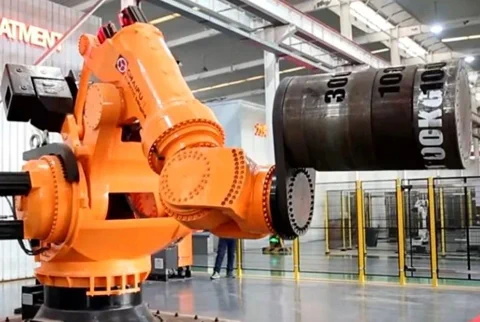
The robot is already being deployed in high-stakes sectors like subway construction, electric vehicle manufacturing, and even nuclear power, where precision and raw power are non-negotiable. According to local authorities, the machine is expected to slash manual labour in hazardous environments by 80% while boosting operational efficiency more than threefold.
Why does this matter?
This is about more than just a fancy certificate and bragging rights. It is a loud, clear signal of China’s rapidly accelerating capabilities in high-end, heavy-duty robotics—a field that has long been the playground of Japanese and European giants. By snatching the global payload crown for the first time, a Chinese firm has proven it can go toe-to-toe with the best in the business.
Perhaps more importantly, Shanghai Chaifu Robot reportedly developed all the core components—the reducers, servo motors, and controllers—entirely in-house. This is a critical milestone for technological self-sufficiency. With ambitious targets to sell 100 of these monsters in 2026, the company isn’t just chasing records; it’s mounting a serious commercial challenge to the established global order of automation. The heavyweight title has officially changed hands.