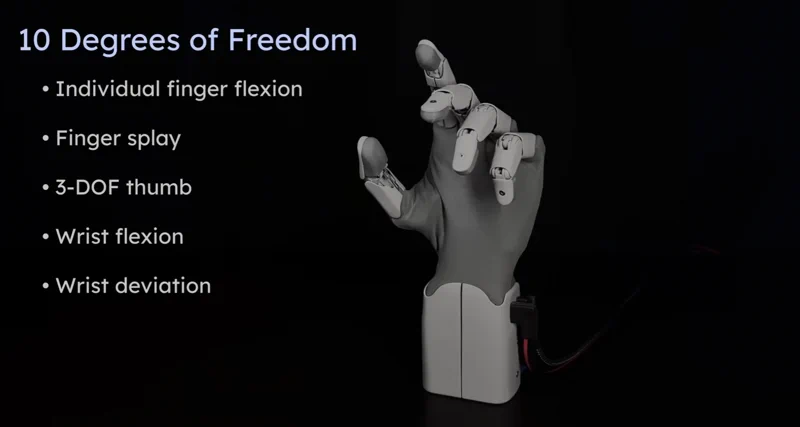
Gesture Platforms has thrown down the gauntlet—quite literally—with the launch of the Gesture HW1 on Kickstarter. The company is betting that researchers, makers, and educators are well and truly fed up with robot arms that end in nothing more than a clunky, glorified arcade claw. The HW1 is a 10-degree-of-freedom (DOF) robotic hand and wrist assembly that aims to deliver high-end finesse without the usual eye-watering price tag.
The project, which smashed through its modest $10,000 funding goal in short order, offers a seriously impressive spec sheet for its sub-$1,000 price point. Weighing in at a nimble 480g, the HW1 boasts 10 actuated degrees of freedom, including individual finger flexion, finger splay, a 3-DOF thumb, and a 2-DOF wrist. This setup allows it to mimic a vast array of human-like grasps and poses with surprising ease. Gesture Platforms is also leaning hard into practicality: the device is designed to be user-repairable with nothing more than a standard hex key, and it ships with a plug-and-play desktop app to bypass the usual software headaches that plague new hardware.
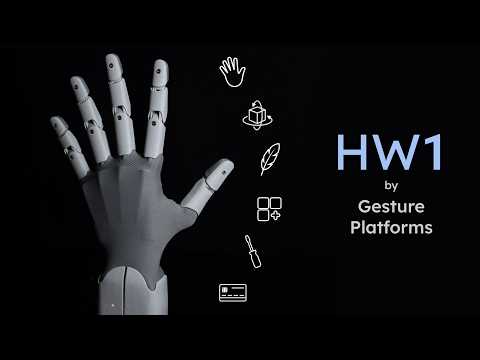
The Kickstarter campaign positions the HW1 aggressively, with early bird tiers starting at $849 (approx. £670), a significant haircut compared to the planned $1,299 (£1,025) MSRP. This puts it in a largely underserved sweet spot: far more capable than budget grippers, but a fraction of the cost of the five- or six-figure hands produced by industry veterans like London’s own Shadow Robot Company.
Why should we care?
For too long, dexterous manipulation has been the “final boss” of robotics, largely because the barrier to entry was financial. Most labs and independent innovators have been priced out of hardware capable of performing complex, human-centric tasks. Projects like Carnegie Mellon’s LEAP Hand, and now the Gesture HW1, are dismantling that paradigm by drastically lowering the cost of admission.
By providing a reliable, repairable, and relatively affordable platform, Gesture Platforms is effectively democratising access to advanced manipulation hardware. This could provide a massive shot in the arm for research in fields like reinforcement learning, human-robot interaction, and teleoperation. It enables smaller teams—and even dedicated individuals—to experiment with tasks that were once the exclusive playground of deep-pocketed corporate labs and elite academic institutions. If the promised Python and C++ SDKs deliver on their potential, the HW1 could very well become a staple bit of kit for the next generation of robotics pioneers.