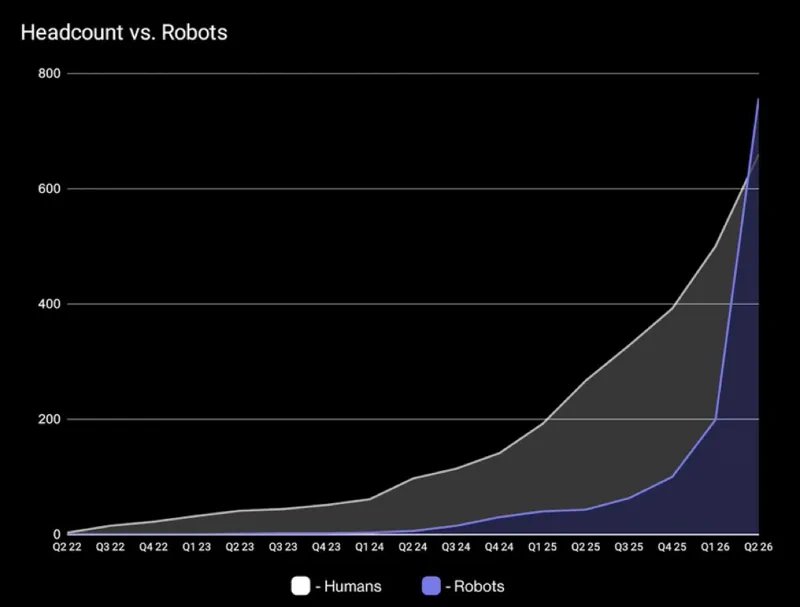
In a move that feels like the opening credits of a particularly slick sci-fi thriller, Figure AI, Inc. CEO Brett Adcock has confirmed that the bots are officially taking over the office. In a post on X, Adcock revealed that the company now has more robots than human employees, sharing a chart that shows the mechanical headcount isn’t just catching up—it’s preparing to leave its biological creators in the dust.
This is a watershed moment for the humanoid robotics startup, which only burst onto the scene in 2022. According to Adcock’s data, the great “crossover” is set to hit its stride in the second quarter of 2026. At that point, the robot population is projected to soar past 700 units, while human staffing levels off at around 650. It’s a clear signal that Figure is pivoting from a high-concept R&D lab into a full-scale manufacturing powerhouse—and it’s a safe bet that the robots are already helping to build their own successors.
With a war chest funded by the likes of Microsoft, NVIDIA, Jeff Bezos, and OpenAI, Figure has been moving at breakneck speed. Their CV is already impressive: a high-stakes partnership with BMW to put its Figure 01 humanoids to work at the carmaker’s Spartanburg plant in South Carolina, and a deep-tech collaboration with OpenAI to bake advanced reasoning and language processing directly into the robots’ “brains.” The goal is a general-purpose worker that doesn’t just follow orders but actually understands the job.
Why is this important?
This isn’t just a bit of clever PR or a vanity metric; it’s a profound shift in how we think about the scalability of labour. While the rest of the industry is busy building prototypes, Figure is assembling a robotic workforce that is outgrowing its own human creators. We’re looking at the first genuine steps toward the “lights-out” factory—a facility run entirely by machines, requiring no human intervention (or heating, or coffee breaks).
This milestone arrives just as the global conversation around AI and corporate personhood is heating up. In Argentina, President Javier Milei has already floated the idea of “non-human corporations”—legal entities owned and run entirely by AI agents, where human shareholders are strictly optional. While Figure still has humans at the helm for now, Adcock’s update proves that the operational reality of an AI-driven workforce is arriving far faster than the regulators can keep up with. The question is no longer if a company can be run by machines, but who will be the first to actually file the paperwork.