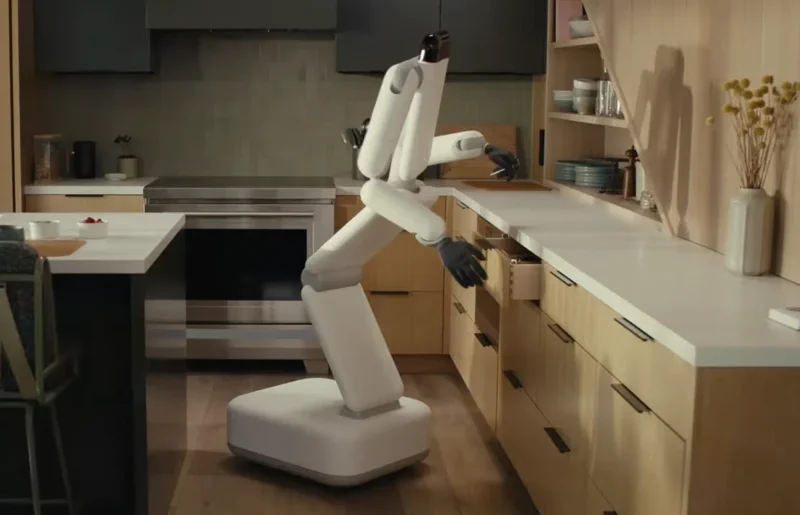
In a humanoid robotics field currently obsessed with churning out metal doppelgängers, Genesis AI has broken cover from stealth with a staggering $105 million seed round and a refreshingly contrarian playbook. The firm has just pulled the silk off Eno, a general-purpose robot that is quite pointedly trying not to look like a person. By ditching the head, opting for wheels over legs, and wrapping the whole affair in a seamless, appliance-like chassis, Genesis is betting that the robot you’ll actually invite into your home won’t look like a sci-fi extra, but rather a piece of high-end Scandinavian furniture.

The design philosophy behind Eno is one of “essentiality and intention”—which is a sophisticated way of saying it’s built for the job, not for winning a beauty pageant. Rising from a nimble wheeled base, its articulated torso can telescope its height and reach before folding down into a compact footprint for storage. You won’t find any exposed motors, messy cabling, or even a single visible screw hole. For those who need a bit of feedback, an optional chest screen can be fitted to display the robot’s “intent,” providing a “cognitive interface” so you can grasp what it’s up to without having to peer into a pair of cold, unblinking camera-eyes.
The real wizardry, however, is located at the end of the arms. Genesis AI has kitted Eno out with proprietary dexterous hands that the company claims mirror human form and function, allowing it to tackle fiddly tasks with millimetre precision. This manual dexterity is orchestrated by GENE, the company’s “robotics-native AI brain,” designed to ensure the hardware and software sing from the same hymn sheet. This “full-stack” approach—building everything from the neural architecture down to the physical finger joints—is what Genesis believes will give it the edge in an increasingly crowded market.
Why does this matter?
While heavyweight rivals like Tesla, Figure, and Agility are burning through billions trying to master the art of the two-legged stroll, Genesis AI is making a savvy side-bet: that wheels are cheaper, safer, and far more sensible for the flat-floored environments where robots will actually work. Co-founder and CEO Zhou Xian argues that the road to mass adoption lies in creating unobtrusive, functional “appliances” rather than uncanny mechanical humans. Armed with a war chest from big-hitters like Eric Schmidt and Xavier Niel, this well-funded startup isn’t just building another gadget; it’s challenging the very DNA of what a helpful robot should be. If they’re right, this could be the “iPhone moment” the industry has been waiting for. We can expect to see the first units rolling out to industrial partners by the end of 2026.