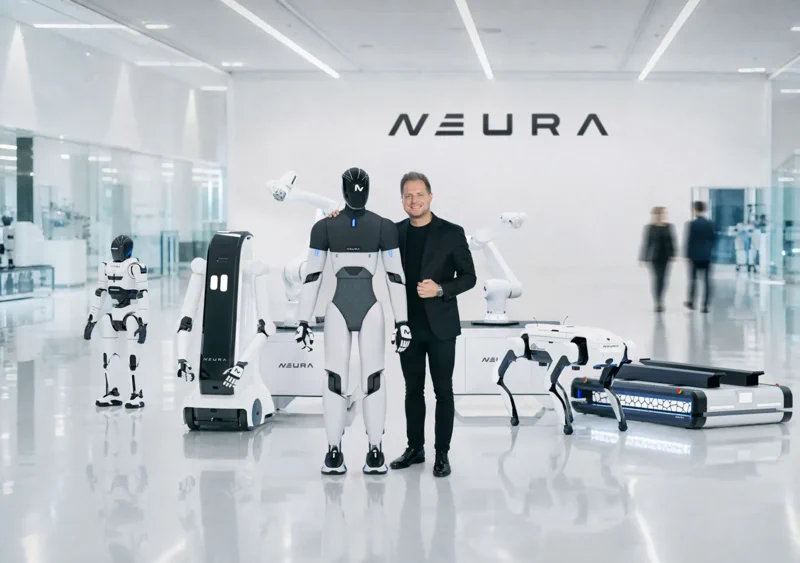
German robotics and AI powerhouse Neura Robotics GmbH has just sent shockwaves through the industry, announcing a gargantuan Series C funding round of up to $1.4 billion (£1.1 billion). The company claims this is the largest-ever investment for a full-stack robotics firm, a move that reportedly catapults Neura’s valuation to a cool $7 billion. The backing comes from a formidable line-up of global heavyweights, including Amazon, NVIDIA, Qualcomm Technologies, and Bosch.
This massive injection of capital is earmarked for the global rollout of Neura’s “cognitive robots” and humanoids, the expansion of its Neuraverse software ecosystem, and an audacious manufacturing scale-up. The goal? To have millions of robots rolling off the assembly lines by 2030. Founded in 2019 in Metzingen, Germany, Neura isn’t just selling a dream; it already boasts a staggering order book worth over $1 billion. The funds will also bankroll the launch of NEURA Gyms—vast, real-world training grounds where its AI-driven machines can hone their skills.
The investor list reads like a “who’s who” of the tech and industrial sectors, but one name provides a fascinating curveball: Tether, the issuer of the world’s most dominant stablecoin. While the interest from chip giants like NVIDIA and industrial stalwarts like Schaeffler is par for the course, Tether’s lead role signals a pivot into the physical world. The crypto titan intends to integrate its wallet development kit into Neura’s platform. The vision? Robots that can autonomously transact and settle payments for the work they perform. It seems the future of the workforce involves machines that don’t just do the heavy lifting, but also handle their own invoicing.
Why does this matter?
This colossal round is a thumping vote of confidence in “Physical AI”—the conviction that the next great leap for artificial intelligence isn’t happening on our screens, but in the physical world. While American and Chinese firms have largely dictated the robotics narrative of late, this investment establishes Neura as a heavily armed European contender in the race for embodied AI.
The carefully phrased “up to $1.4 billion” suggests a nuanced deal likely tied to specific performance milestones rather than a simple blank cheque. Nevertheless, it hands Neura a formidable war chest to take on the biggest names in the humanoid space. The real test now lies in execution: transforming billions in venture capital into millions of reliable, working robots capable of functioning beyond the sterile confines of a lab. The race to build the world’s robotic workforce has just hit overdrive.