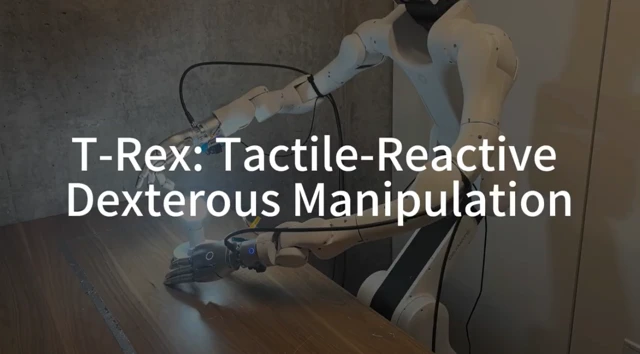
In a field where robots often possess the delicate touch of a runaway JCB, a team of researchers has unveiled a framework ironically dubbed T-Rex. Its mission? To gift machines a crucial, yet conspicuously absent, capability: reactive touch. A collaboration between academic heavyweights at UC Berkeley, NVIDIA, Stanford, and other top-tier institutions, the project has demonstrated a staggering 30% leap in success rates for complex manipulation tasks compared to the most advanced vision-only models. This isn’t just a minor tweak; it’s a fundamental shift in how robots navigate and negotiate the physical world.
Most contemporary robots, powered by Vision-Language-Action (VLA) models, are effectively operating in the dark the moment they make contact with an object. They can see, they can plan, and they can move—but they cannot feel if an object is slipping or deforming in their grasp. T-Rex fixes this by weaving high-frequency tactile feedback directly into the decision-making loop. To power this, the team has released a massive 100-hour dataset of tactile-synchronised manipulation, featuring over 7,700 trajectories across more than 200 objects—providing the vital data that has been the industry’s Achilles’ heel for years.
The real magic under the bonnet is a novel Mixture-of-Transformers (MoT) architecture. This design cleverly bifurcates the robot’s “brain,” employing a low-frequency expert for high-level visual planning while a dedicated high-frequency expert processes the relentless stream of touch data for real-time adjustments. This allows the robot to master delicate feats—such as screwing in a lightbulb, handling a fragile egg, or deftly sliding a single card from a deck—tasks that are trivial for us but a total nightmare for a touch-blind machine. In a move that will delight the robotics community, the entire project—including the dataset, models, and training code—is being fully open-sourced.
Why does this matter?
For years, robotic manipulation has been stuck in a cycle of “look but don’t touch”—or rather, “touch, but don’t feel.” By ignoring tactile input, we’ve essentially been asking robots to assemble flat-pack furniture while wearing thick oven mitts. T-Rex’s success is proof that tactile sensing isn’t a luxury; it’s the “secret sauce” required to achieve human-level dexterity. By making the entire stack open-source—from that 100-hour dataset to the MoT architecture—the team has significantly lowered the barrier to entry for researchers worldwide. This could well trigger a “Cambrian explosion” of innovation, leading to a generation of robots that can finally handle the world with the finesse it demands. We’re moving toward a future where robots don’t just pick things up and put them down; they finally know how to use their hands.
You can dive into the technical details on the project website, read the full paper on arXiv, and access the code on GitHub.