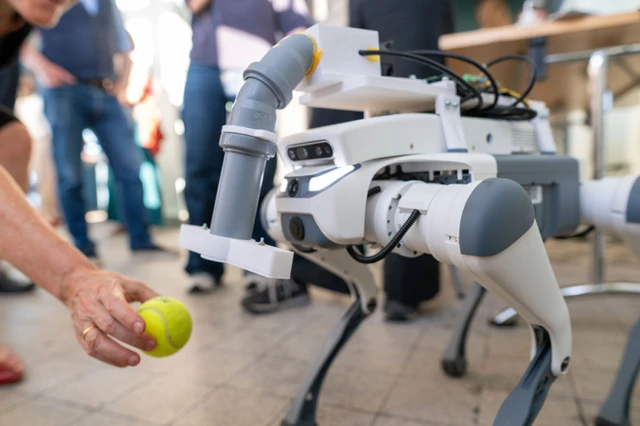
While the rest of the robotics world remains fixated on teaching machines to see, walk, and babble, Deep Robotics is following its nose—literally. At the “Future of Smell” exhibition hosted by Germany’s Dresden University of Technology, the firm showcased a modified version of its Lite3 quadruped, equipped with an “electronic nose” that effectively turns the robot into a high-tech bloodhound for the digital age.
The souped-up Lite3 navigated a cluttered exhibition hall with poise before pausing at a designated test point to take a “deep breath.” Its onboard e-nose system captured airborne scent signals, which were then instantly processed by AI algorithms to pinpoint specific chemical signatures. The demonstration was, by all accounts, a triumph; German researchers on-site were reportedly heard exclaiming, “It really smelled it!” This shift transforms the robot from a mere “camera on legs” into a sophisticated sensory platform capable of sniffing out dangers that remain invisible to the human eye.
The hardware itself is no slouch. By mounting the electronic nose onto the agile Lite3 base, Deep Robotics has created a scout that can operate for up to two hours, carry a 7.5 kg payload, and tackle 40-degree inclines. This level of mobility allows the bot to venture into hazardous, cramped, or high-risk environments where humans—and their actual noses—fear to tread, such as locating gas leaks or identifying the source of industrial pollution.
Why does this matter?
Giving a robot a sense of smell is a massive leap for “embodied AI.” It moves the needle from passive observation to active environmental interrogation. In an industrial setting, this means a robot could autonomously patrol a factory floor and detect a faint chemical leak long before it becomes a full-blown catastrophe. In a search-and-rescue scenario, it could potentially identify the chemical signature of a survivor trapped under rubble. By fusing mobility with an artificial olfactory system, Deep Robotics has created a “closed-loop” of perception, analysis, and early warning. It’s a timely reminder that in the world of safety and inspection, the most critical threats are often the ones you can’t see, but can definitely smell.