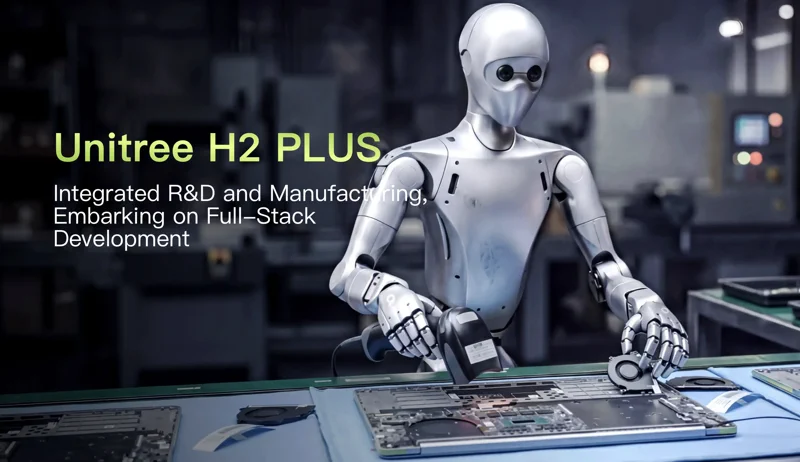
Just when you thought the humanoid robot arms race couldn’t get any more frantic, Unitree Robotics has decided to give its H2 model a serious cognitive overhaul. The newly unveiled Unitree H2 Plus is less of an incremental update and more of a full-blown brain transplant, thanks to the integration of NVIDIA’s monstrously powerful Jetson Thor superchip. This move firmly positions the H2 Plus as the high-end development platform of choice for the next generation of AI-driven robotics.
The H2 Plus itself is a formidable bit of kit even before you look under the bonnet. Standing at 6ft (1.82m) and weighing in at 70kg, it has a commanding physical presence. The robot boasts 31 degrees of freedom (DOF) in its main chassis, delivering impressive peak torque figures of 360 N·m in the legs and 120 N·m in the arms. But the real showstopper is the optional Dual SharpaWave Tactile Five-Finger Dexterous Hands. These add a further 22 degrees of freedom per hand, bringing the grand total to a dizzying 75 DOF. Each fingertip on these advanced manipulators is packed with over 1,000 tactile pixels, granting the robot a sense of touch with a force sensitivity as delicate as 0.005N.
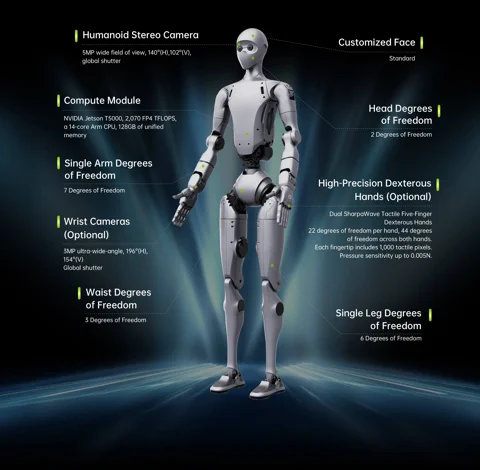
The star of the show, however, is the NVIDIA hardware and software stack. The Jetson Thor system-on-module provides a staggering 2,070 TFLOPS of FP4 AI performance, powered by the cutting-edge Blackwell architecture GPU and a 14-core Arm CPU. This onboard supercomputer is purpose-built to run the entire NVIDIA Isaac platform, including the GR00T foundation models designed for general-purpose robotic tasks. In practice, this means developers can tap into NVIDIA’s exhaustive suite of tools for simulation (Isaac Sim), data capture (Isaac TeleOp), and deploying trained policies directly onto the hardware.
Why this matters
Unitree, a company that initially built its reputation on surprisingly affordable and agile quadrupeds, is now making an aggressive land grab in the high-performance humanoid arena. By partnering with NVIDIA to create an open reference design, Unitree isn’t just shifting units; it’s offering a complete, research-ready ecosystem. This significantly lowers the barrier for academic and commercial labs to get stuck in with top-tier hardware that’s already been harmonised with a powerful AI software stack. Rather than spending months wrestling with component integration, researchers can jump straight into developing complex skills and behaviours using GR00T foundation models. The H2 Plus is a direct shot across the bows of more vertically integrated players, betting that an open, powerful, and accessible platform will be the one to accelerate the entire field.